

Oral cancer is an often-overlooked health issue that affects tens of thousands of Americans every year. As a resident of Metairie or elsewhere in Louisiana, you may not realize how this national trend plays out in your own community.
In this article, we’ll explore how oral cancer impacts people on a national and local level and what you can do to protect yourself.
We’ll break down the latest U.S. and Louisiana statistics, highlight why early detection is so critical, and examine the lifestyle risks (like smoking and alcohol) that hit home in our area.
The goal is to give you a friendly, informative snapshot of the oral cancer landscape, from coast to bayou, with clear takeaways you can use to safeguard your smile and health.
Stay proactive about your oral health, schedule your routine exam in Metairie, LA today.
Nearly 60,000 Diagnosed Annually: What You Should Know About Oral Cancer

Oral cancer, which includes cancers of the mouth and throat (oropharyngeal cancer), is more common than many people think. Nationwide, about 59,660 Americans will be diagnosed with oral or throat cancer this year.
In fact, oral cancers account for roughly 3% of all new cancer cases in the U.S., placing it among the more prevalent cancers. Men are about twice as likely as women to develop these cancers, partly due to historically higher tobacco and alcohol use.
Most patients tend to be older adults, but cases in younger people are on the rise due to changing risk factors (more on that later).
How does Louisiana compare? Unfortunately, our state sees slightly higher rates of oral cancer than the nation as a whole. Louisiana averages around 13.2 new cases per 100,000 people each year, a bit above the U.S. rate of 12.0 per 100k. That comes out to roughly 742 Louisianans diagnosed annually with oral or throat cancer.
The burden isn’t evenly spread: some rural parishes with high tobacco use have incidence rates double the state average.
Closer to home in Jefferson Parish (where Metairie is located), the oral cancer rate is actually slightly lower – about 11.2 per 100,000, equating to an average of 64 new cases in the parish each year. Jefferson’s incidence has remained relatively stable, but statewide the trend is creeping upward.
Since the mid-2000s, oral/oropharyngeal cancer diagnoses have been increasing by around 1% per year, largely due to a rise in cancers linked to human papillomavirus (HPV) infections. HPV-related throat cancers are becoming more common, even as smoking rates slowly decline, shifting the landscape of who is at risk.
So what does this mean for you as a Metairie resident? Essentially, oral cancer is a significant health concern both nationally and in Louisiana.
Thousands of families (including dozens every year right here in our parish) are affected by it. It can develop in the tongue, gums, tonsils, throat or other parts of the mouth, often without obvious symptoms at first. Knowing that Louisiana’s incidence is slightly above average should put us on alert to be proactive.
The good news is that awareness is the first step to prevention and early detection. In the sections below, we’ll discuss how catching oral cancer early can literally be life-saving, and how lifestyle factors prevalent in our region play a role.
By understanding the scope of the issue, you’re better equipped to protect yourself and your loved ones from becoming part of these statistics.
Concerned about changes in your mouth? Book a prompt oral health evaluation.
Nearly 13,000 Lives Lost Annually: Why Early Detection Matters
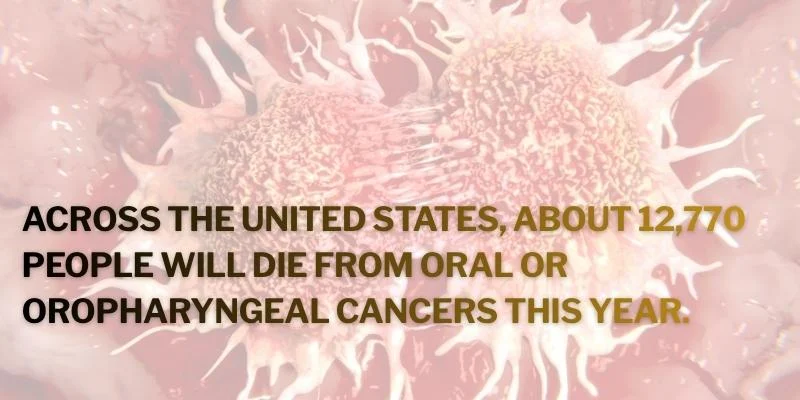
Oral cancer can be deadly – especially if it’s not caught early. Across the United States, about 12,770 people will die from oral or oropharyngeal cancers this year. To put that in perspective, that’s an average of one life lost every hour, every day.
The overall 5-year survival rate is only around 65–70%, meaning roughly one in three people diagnosed will not survive five years.
The critical factor that determines survival is how early the cancer is detected and treated. When oral cancer is discovered at an early, localized stage, the prognosis is very good – the five-year survival is about 85–90%. Unfortunately, only about 1 in 4 cases (26%) are caught at this localized stage.
The majority are not found until the cancer has already spread to lymph nodes or other tissues. By the time it reaches an advanced stage (Stage III or IV), the five-year survival rate plummets.
More than 70% of oral cancers are diagnosed at Stage III/IV, when survival odds drop below 50%. In other words, late detection can be a death sentence, whereas early detection can mean the difference between life and death.
Why are so many oral cancers caught late? A big reason is that in early stages, oral cancer can be painless and easy to overlook.
A small sore or white patch in your mouth might be shrugged off as harmless. Often, there’s no obvious warning sign until the cancer is more advanced and causing pain, difficulty swallowing, or a visible lump.
This is why regular dental check-ups are absolutely essential. Dentists can often spot suspicious lesions during routine exams – long before you would notice something is wrong.
If you haven’t been seeing a dentist at least once a year, you could be missing the opportunity to catch oral cancer early.
Cost or access to care can be barriers (an issue for many in Louisiana), but there are programs and community health centers that offer screenings. Simply put, don’t wait for pain or visible problems to get your mouth checked. By then, it might be too late.
It’s also important to know the common signs and symptoms of oral cancer, so you can seek help sooner.
Red or white patches in the mouth, a sore that doesn’t heal within two weeks, unexplained bleeding, persistent sore throat or hoarseness, a lump in the neck, or difficulty chewing and swallowing – these should not be ignored.
If any of these symptoms lasts more than a couple of weeks, see a dentist or doctor promptly. Early-stage oral cancers are often treatable with less invasive methods, and patients can go on to live healthy lives.
For example, a small tongue tumor might be removed surgically or treated with targeted radiation, with minimal impact on speech or eating.
But if that same tumor grows unchecked to an advanced stage, treatment might involve extensive surgery, chemotherapy, or radiation that can greatly affect quality of life – and still with lower odds of survival.
The bottom line for Metairie residents (and everyone): early detection saves lives. Our community has seen its share of oral cancer cases and, sadly, oral cancer deaths.
By staying vigilant for symptoms and keeping up with dental exams, you can improve the odds that if oral cancer ever does occur, it’s caught and treated early.
Talk to your dentist – many offer quick, painless oral cancer screenings as part of your check-up. It could make all the difference.
Get peace of mind with a quick, painless oral screening, your health is worth the check.
80% of Oral Cancers Linked to Tobacco & Alcohol: How You Can Lower Your Risk
When it comes to oral cancer, an ounce of prevention is worth a pound of cure. The majority of oral cancer cases are linked to lifestyle factors – meaning there’s a lot you can do to reduce your risk.
Tobacco use is the #1 culprit. Studies show that roughly 8 in 10 people with mouth cancer have a history of using tobacco (cigarettes, cigars, pipes, or chewing tobacco). Smoking in particular is a huge risk factor: long-term smokers have many times the oral cancer risk of non-smokers.
Heavy alcohol consumption is number two on the list. Most oral cancer patients are or were heavy drinkers, and alcohol works with tobacco to wreak even more havoc.
In fact, the combination of smoking and drinking is especially deadly – together, tobacco + alcohol account for about 80% of oral cancer cases in men (and about 65% in women).
These substances irritate and damage the cells lining the mouth and throat, causing mutations that can turn cancerous over time. If you both smoke and drink heavily, your risk of oral cancer is 15 times higher than someone who never smoked or drank, according to cancer experts.
Here in Louisiana – and in Metairie specifically – these risk factors hit close to home. Our state unfortunately has higher tobacco usage than the national average. As of 2022, about 16.7% of Louisiana adults smoke, compared to 14.0% nationwide.
That higher smoking rate means a larger share of our population is at risk of tobacco-related illnesses, including oral cancer.
Alcohol use is also prevalent; roughly 17% of Louisiana adults report excessive drinking (similar to U.S. averages). Culturally, enjoying a cocktail, a beer at a festival, or a night out in New Orleans is part of the social fabric.
There’s nothing wrong with responsible drinking – but it’s important to know that heavy drinking (defined as more than 1 drink/day for women or 2 drinks/day for men, or frequent binge drinking) markedly raises oral cancer risk, especially when combined with tobacco.
Beyond tobacco and alcohol, another modern risk factor has emerged: human papillomavirus (HPV).
This common virus (transmitted through intimate contact) is now linked to a growing number of throat cancers, particularly in the tonsils and base of the tongue. HPV is believed to cause about 70% of oropharyngeal (throat) cancer cases in the U.S..
These HPV-related oral cancers often occur in younger individuals who may have never smoked or only smoked lightly. The rise of HPV-related cases is a big reason why overall oral cancer numbers have not declined even as smoking rates have fallen.
The good news is that HPV-related throat cancers tend to respond well to treatment, and there’s also a highly effective HPV vaccine that can prevent the infections most likely to cause cancer.
The CDC recommends this vaccine for preteens (boys and girls around age 11-12) and catch-up doses for teens and young adults who missed it. By increasing HPV vaccination rates in Louisiana, we can protect the next generation from many cases of oral and other cancers.
So, how can you lower your own risk of oral cancer? The advice is straightforward, and it works: avoid tobacco entirely, and limit your alcohol consumption.
If you’re a smoker or use smokeless tobacco, seek help to quit – it’s never too late to stop. Your risk of oral cancer (and a dozen other diseases) will drop significantly within just a few years of quitting.
Louisiana offers resources like quitlines and cessation programs to support you. If you drink, do so in moderation. The general guideline is no more than one drink per day for women or two for men – and even less is better.
Also, maintain good oral hygiene and a healthy diet rich in fruits and vegetables, which may help bolster your oral health.
And don’t forget the HPV vaccine for yourself if you’re eligible (typically up to age 26, and in some cases 45) or for your children – it’s a proven cancer prevention tool.
Lastly, continue those regular dental visits, because dentists not only catch cancer early but can also counsel you on risk factors and oral health habits.
By controlling what you can – tobacco, alcohol, HPV, and oral hygiene – you tilt the odds in your favor. You have more power than you might think to prevent oral cancer from ever affecting you or your family.
References
- American Cancer Society – Key Statistics for Oral Cavity and Oropharyngeal Cancers (2025)cancer.orgcancer.org. (National annual cases, deaths, and trends for oral/oropharyngeal cancer.)
- National Cancer Institute (CDC) – State Cancer Profiles: Oral Cavity & Pharynx Cancer Incidence in Louisiana (2017–2021)statecancerprofiles.cancer.govstatecancerprofiles.cancer.gov. (Louisiana and Jefferson Parish oral cancer incidence rates and case counts.)
- Memorial Sloan Kettering Cancer Center – Mouth Cancer Risk Factors & Preventionmskcc.orgmskcc.org. (Research noting ~80% of mouth cancers in men linked to tobacco/alcohol, and 8 in 10 oral cancer patients use tobacco.)
- Truth Initiative – Tobacco Use in Louisiana (2023)truthinitiative.org. (Statistics on Louisiana’s adult smoking rate vs. the U.S. average, highlighting higher tobacco use in LA.)
- Touro University News – Early Detection for Mouth and Throat Cancers (Sept 2023)touro.edu. (Article emphasizing that 70% of oral cancers are found at late stage III/IV with <50% survival, vs ~84% survival if caught early.)
- Anne Arundel County Health Dept. – Oral Cancer FAQ and Preventionaahealth.orgaahealth.org. (Public health resource noting 12,770 annual deaths, ~67% 5-year survival, and that HPV causes ~70% of oropharyngeal cancers.)
- NCI SEER Cancer Stat Facts – Oral Cavity and Pharynx Cancerseer.cancer.govseer.cancer.gov. (Data showing only 26% of cases are localized at diagnosis (88% survival), majority are regional/distant; also that men have ~2× the risk of women.)