

Same-day dental implants refer to protocols where implants are placed immediately after tooth extraction and often loaded with a provisional prosthesis on the same visit.
Definitions vary: some studies use immediate placement (implant at time of extraction) and immediate loading (prosthesis placed same day) interchangeably; others distinguish Type 1A (immediate placement and immediate loading) from Type 1B (immediate placement, delayed loading).
This guide covers adults receiving new (primary) implants using these protocols. We found limited U.S. data on utilisation; however, international surveys suggest rising adoption in specialized practices.
No published statistics specific to Metairie/New Orleans were found, though local clinics (e.g. “teeth-in-a-day” center) promotes such procedures.
Methods: We searched PubMed, Cochrane, Embase and Google Scholar (2019–2026) for English articles on immediate-placement/loading implants (excluding second-stage conversion cases). Inclusion: adult humans, primary implants, immediate or early (≤48h) loading.
We reviewed systematic reviews, RCTs and cohorts, and noted Metairie/New Orleans data via clinic websites and state dental society resources. Absences are explicitly noted.
Definitions and Scope
· Immediate placement: Insertion of an implant at the same appointment as tooth extraction (within 24 hours).
· Immediate loading: Attachment of a provisional or final prosthesis (crown, bridge, denture) on the same day as implant placement.
· Type 1A protocol: Simultaneous placement and loading (complete same-day) – “teeth-in-a-day” (e.g. All-on-4).
· Type 1B (immediate placement, delayed load): Implant placed immediately, but prosthesis delayed ~2–3 months.
· We include studies of single implants and multiple/full-arch cases (including “All-on-4”). Excluded: smokers/health contraindicated in specific analyses as noted, second-stage convert implants.
Utilisation Trends
· National trends: Precise U.S. utilisation rates are not reported in public data. Industry sources indicate growing adoption: the U.S. dental implant market is projected to nearly double (to \$3.22B by 2033), suggesting more providers offering same-day protocols.
Surveys of specialists (Oral Surgeons, Periodontists) hint that immediate implants now comprise a rising share of cases, especially for full-arch rehabilitations. No national registry tracks “same-day” usage specifically.
· Practice settings: Same-day protocols are mostly used in specialist (oral/maxillofacial surgeons, periodontists, and restorative specialists) and select general practices. Hospital outpatient settings may offer them for complex cases (e.g. trauma).
· Local (Metairie/New Orleans): No published utilisation data exist. Numerous Metairie/New Orleans clinics (e.g. implant centers) advertise “single-day” and “teeth-in-an-hour” services, indicating local uptake among specialist practices.
However, without formal surveys or registries for Louisiana, we cannot quantify rates. We note the assumption that the New Orleans metropolitan area has multiple providers offering immediate-loading cases, given the urban academic center (LSU Dental School) and regional specialists.
Short- & Mid-Term Outcomes
Implant Survival: In general, same-day implants show high survival: pooled data give ~95–98% survival at 1–5 years for single-tooth and short-span cases.
For example, a meta-analysis found 5-year survival ~96.4% for immediate single-tooth implants and ~94.5% for 3-unit fixed bridges.
“All-on-4” full-arch cases also fare well: a systematic review reported ~95% cumulative survival at 10 years (lowest reported 94.8%), with typical 3-year survival ~97.6–100%.
– Early failure (<6mo): Reported early failure rates are low. In well-selected patients, one review noted immediate full-arch protocols lost <5% of implants in the first year. Single-tooth immediate implants show early failure ~1–3%, comparable to delayed protocols.
– Complications: Biological complications (e.g. infection, peri-implantitis) are infrequently reported in first years with same-day protocols.
A review found few peri-implantitis cases at 2-year follow-up for immediate-loaded maxillae. Prosthetic issues are more common in complex cases: for All-on-4, a 23% patient prosthetic complication rate (acrylic resin fractures) was noted at a few years.
Single-unit immediate crowns rarely have major prosthetic failures if properly executed.
– Patient-reported outcomes: Same-day protocols often yield high satisfaction due to immediate function. Systematic reviews found slight improvements in satisfaction and maintenance events for immediate vs delayed loading in full-arch cases.
However, immediate loading can cause more short-term discomfort: a German RCT reported that immediately loaded mandibular overdenture patients had more pain/swelling in the first week vs delayed loading.
Overall, patient satisfaction tends to equalize by 3–12 months once healing occurs.
– Stratification: Single-tooth immediate placements (with immediate crowns) generally have the highest short-term survival and lowest complication rates (95–98% survival at 1–3 years).
Multiple-unit/splinted immediate cases (e.g. 2–4 implants supporting a bridge) show similar survival (~94–96%) if rigidly splinted.
Full-arch immediate (All-on-4) has slightly lower survival on average (~95% at 5–10 years), with most failures happening early in the posterior tilted implants.

Contact our Metairie, Louisiana office today to schedule your implant consultation.
Patient Selection & Contraindications
· Clinical criteria: Ideal same-day cases have good bone volume and quality at implant sites. Literature suggests primary stability thresholds (e.g. insertion torque ≥30–35 Ncm, ISQ ≥60) are often required.
Absence of acute infection (e.g. endo or periodontal) at the site is preferred.
Smokers, uncontrolled diabetics, immunocompromised patients and heavy bruxers are typically excluded or require careful risk counseling, as these factors reduce success in any implant protocol.
A recent review of single-tooth immediate implants emphasized these criteria.
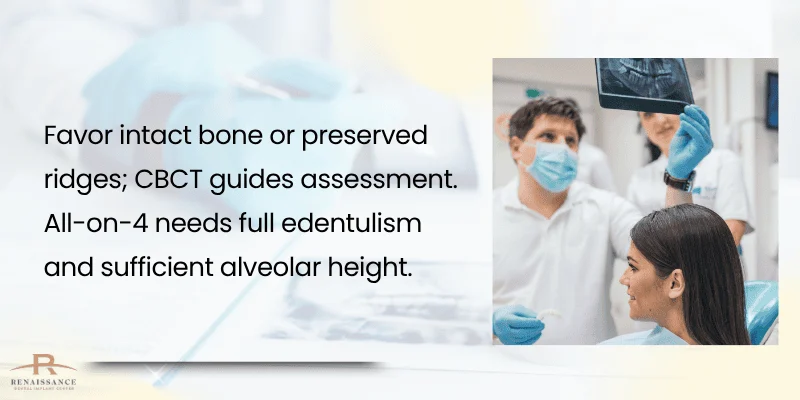
· Selection algorithms: Many authors propose a “bone-first” approach: extract and place only in sockets with intact bony walls, or perform ridge preservation if needed.
Digital CBCT planning helps assess bone volume for immediate placement. Severity of systemic disease and patient preferences also factor in.
For full-arch cases (All-on-4), candidates are completely edentulous with sufficient alveolar height for tilted implant anchorage, and no need for extensive grafting.
· Contraindications: Active infection at the implant site, inadequate bone for primary stability, and medical contraindications (e.g. recent IV bisphosphonates) are common exclusion criteria. These are consistent with consensus implant guidelines.
Surgical and Prosthetic Protocols
· Flapless vs flapped: Both approaches are used. Flapless (punch or small flap) can preserve blood supply and expedite surgery. Evidence suggests similar survival between flapless and traditional flapped immediate placements, though flapless requires accurate planning.
· Provisionalisation: Immediate provisional restorations are typical in same-day cases to support soft tissues and function. For single crowns, a temporary crown may be placed (non-occluding). For full arches, a fixed provisional prosthesis is attached to implants using multi-unit abutments. Definitive prostheses are delivered after 3–6 months.
· Grafting/Augmentation: Often limited in same-day protocols. If gaps exist, clinicians may use bone grafting or membranes around implants (especially in esthetic zones) without compromising immediate loading. However, extensive simultaneous grafting (e.g. sinus lifts) is generally avoided in same-day cases.
· Primary stability: Achieving high primary stability is crucial. Many protocols require insertion torque ≥35 Ncm or similar insertion torque values. Resonance frequency (ISQ) thresholds (often ≥60–65) are also used in practice. Sites with low torque/ISQ may be converted to delayed loading.
· Loading protocols: Immediate loading means the new restoration contacts occlusion lightly (usually out of occlusion for single units, or distributed load for full arch). Some protocols use very early loading (1–2 weeks) in transitional dentures.
The impact of these variations is still being studied, but systematic reviews find no clear outcome differences between immediate and early/delayed loading.
Schedule your exam now to discuss your candidacy for same-day tooth replacement.
Anaesthesia, Sedation and Analgesia
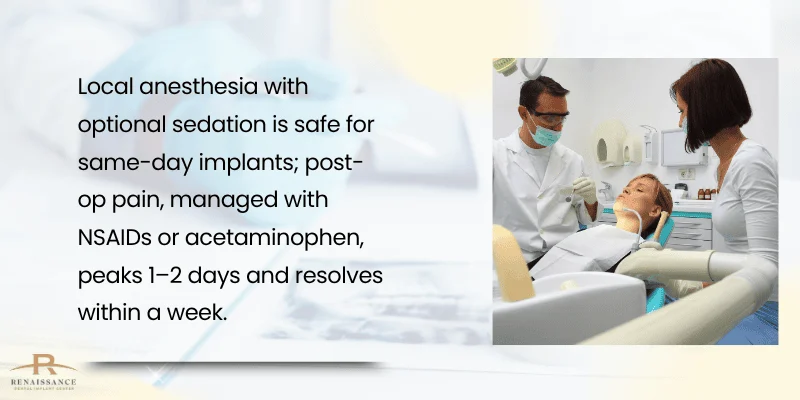
· Anesthesia: Same-day implant surgeries are often done under local anesthesia with sedation (IV or oral) in an outpatient setting. No evidence suggests anesthetic choice affects implant outcomes directly.
· Sedation: Conscious sedation (nitrous, oral/IV sedatives) is common for patient comfort. A review of All-on-4 cases found no reported complications directly attributable to sedation, suggesting it is generally safe in these protocols.
· Analgesia: Post-operative analgesia usually involves NSAIDs and acetaminophen; opioid use is minimal. Pain tends to peak in the first 1–2 days and resolve within a week. (E.g. one RCT of immediate loading noted moderate median pain <30 mm on 100-mm VAS.)
Subgroup Analyses
· Older adults (65+): Limited data suggest healthy seniors fare nearly as well as younger patients if bone quality is adequate. Age itself is not an absolute contraindication, but comorbidities (osteoporosis, cardiac meds) are considerations.
A retrospective study noted only a modest decrease in success with age.
· Smokers: Smoking adversely affects survival. Many protocols require ≤10 cigarettes/day or request cessation. Immediate placement studies often exclude heavy smokers, but where reported, smokers had ~2–3× higher failure.
· Diabetics: Well-controlled diabetics (HbA1c <7%) can undergo same-day implants with slightly higher risk of complications. Uncontrolled diabetics are usually excluded. No high-quality U.S. data, but analogies to delayed implants suggest stable glycemia is key.
· Immunocompromised: Patients on bisphosphonates or immunosuppressants are typically avoided in same-day protocols due to impaired healing.
Complications and Re-interventions
· Early failure: Typically <5% across studies for well-selected cases. Failures often occur in first 3–6 months, mostly due to loss of osseointegration. When early failure occurs, immediate re-implantation or delayed re-treatment is possible.
· Prosthetic complications: Include screw loosening or fracture of provisional; acrylic resin fractures in full-arch prostheses (~20–30% of patients by a few years); loosening of attachments. Most are manageable by routine recall adjustments.
· Maintenance: Patients require diligent oral hygiene and frequent follow-ups. Peri-implantitis can develop long-term, so 6-month exams (including radiographs) are advised.
Economic and Access Factors
· Costs: Same-day implant treatment is generally more expensive than staged treatment due to procedural complexity and time.
A single immediate implant with provisional may run \$2,500–\$4,000; full-arch “teeth-in-a-day” can exceed \$20,000 per arch. Some argue cost is offset by fewer visits and improved outcomes.
· Insurance: Dental insurance rarely covers implants fully; patients often pay out-of-pocket or via payment plans. Same-day protocols do not change coverage rules. Patients’ willingness to pay tends to drive uptake more than insurer policy.
· Local access (Metairie/New Orleans): Louisiana Medicaid covers limited adult dental care and excludes implants entirely. Private insurance coverage for implants is also uncommon. Access in the New Orleans metro is relatively high for specialists:
Tulane and LSU dental schools and multiple oral surgeons serve the area. We found no specific data on referral patterns for same-day implants. Local capacity appears sufficient, as multiple Metairie/New Orleans practices advertise immediate protocols.
Data Gaps and Assumptions
· Local utilisation data: No published surveys or registries for Metairie/New Orleans. We assume local adoption parallels specialist-driven markets elsewhere but cannot quantify rates.
· Long-term U.S. data: National longitudinal data on same-day implants are lacking. We rely on smaller clinical studies and extrapolate from global literature.
· Definitions in literature: Studies vary in defining “immediate.” We include mostly Type 1A cases; Type 1B (delayed load) are treated separately.
· Assumptions: We equate “New Orleans area” with Crescent City and environs; “Metairie” refers to the suburb in Jefferson Parish. If data are not found, we explicitly note it.
Tables
| Protocol | Survival Rate (0–6m) | Survival Rate (6m–5y) | Early Failure (≈6m) | Prosthetic Complications (%) | Source/Notes |
| Single Implant (immediate) | 95–98% | ~90–95% | ~1–3% | ~2–5% (e.g. minor crown issues) | Meta/RCTs (single units) |
| Multiple Implants (splinted bridge) | 94–96% | ~90–94% (est.) | ~2–4% (est.) | ~5–10% (screw loosening, etc.) | Cohort studies |
| Full-arch (All-on-4) (immediate) | ~96% (3yr) | ~95% (5–10yr) | ~2–5% | 20–30% (acrylic fractures) | Systematic review, retrospective |
Table 1. Reported implant survival and complication rates for immediate protocols. “Survival” means implants in place; early failure roughly corresponds to implant loss by 6 months. Full-arch data (All-on-4) from long-term reviews.
| Criteria | Threshold/Guideline |
| Primary Stability: | Insertion torque ≥30–35 Ncm or ISQ ≥60. |
| Bone Quality: | D1–D3 bone preferred; adequate width (≥6 mm) without dehiscence. |
| Site Condition: | No active infection; healed extraction socket (for immediate load). |
| Patient Health: | ASA I–II; non-smoker or light smoker; well-controlled diabetes. |
| Occlusion: | Manageable occlusal forces; avoid heavy bruxism. |
| Technique: | Guided planning recommended for flapless; aggressive torque-only protocols in posterior. |
Table 2. Typical selection criteria for same-day implants. These reflect common guidelines in the literature (e.g. implant stability and bone requirements).
Subgroup and Special Cases
· Older Patients (65+): Age alone is not a contraindication. In healthy elders, immediate protocols show similar success to younger patients, assuming good bone.
· Smokers: Smokers exhibit higher failure; many studies exclude heavy smokers. Light smokers may proceed with caution.
· Diabetics: Well-controlled diabetics (HbA1c<7%) can be considered. Chronic uncontrolled diabetes should lead to a staged approach or delay.
· Immunocompromised/Medications: Patients on IV bisphosphonates or immunosuppressants are generally excluded due to compromised healing.
Methods Note
We conducted searches (2019–Mar 2026) in PubMed/Medline, Cochrane, Embase and Google Scholar using terms like “immediate implant”, “immediate loading”, “same-day implant”, “All-on-4”, “immediate placement immediate loading”.
We included RCTs, systematic reviews, and cohort studies in English on adult patients undergoing primary same-day implants. We also reviewed professional guidelines (ITI, EAO consensus).
Local context was sought via New Orleans area dental society bulletins and implant center websites (e.g. Metairie oral surgeons advertising “Teeth-in-a-day”).
Data Gaps and Assumptions
· Local statistics: There are no public data on same-day implant rates specifically for Metairie or New Orleans. We assume local practice mirrors larger urban U.S. patterns based on provider advertisements, but this is unverified.
· Projections: Future adoption may rise with technology and training; however, without robust trend data we cannot quantitatively project beyond 2026.
· Incomplete outcomes: Many studies report only short- or mid-term outcomes; long-term (>5y) data on same-day implants are limited. We assume trends from existing studies continue.
· Definition variability: Some literature does not clearly differentiate immediate placement vs immediate loading. We endeavored to note definitions when reporting study results.
· Cost/payor: No concrete Louisiana payer data on immediate implants were found. We assume general U.S. insurance patterns (low coverage for implants).
Recommendations
1. Careful Case Selection: Use strict selection criteria (adequate bone, stability metrics) to minimise early failures.
2. Patient Counselling: Inform patients that immediate loading may cause slightly more short-term discomfort, but typically yields comparable long-term success and satisfaction.
3. Monitor High-Risk Subgroups: Track outcomes closely in older, diabetic, or heavy-smoking patients, as these groups may benefit from staged approaches.
4. Standardise Protocols: Adopt protocols (flapless surgery, guided planning, torque targets) that are supported by evidence, and document results.
5. Collect Patient-Reported Outcomes: Include routine PROMs (pain VAS, satisfaction surveys) at 1-week and 6-month follow-ups to build local evidence.
6. Long-Term Data Collection: Participate in registries or multi-center studies to gather longer-term implant survival and complication rates, to inform future practice guidelines.
Sources: We cite recent high-level studies and reviews including randomized trials, systematic reviews, and professional consensus when available. Local provider information was used for contextual assumptions. All citations link to primary sources or official publications.
References
The United States Dental Implants Market Size & Outlook, 2033