


When you lose a tooth or face the decision to extract one, you need to know whether saving your natural tooth or getting a dental implant is the better choice. Many people assume implants are always superior to natural teeth because of marketing and online information, but the reality is more complex.
The survival rates of healthy natural teeth consistently outperform dental implants, making tooth preservation the priority whenever possible.
Your natural teeth have unique advantages that implants cannot replicate. They contain nerves that help you sense pressure and temperature, they have a natural shock-absorbing system, and they don’t require surgery to maintain.
However, when a tooth is severely damaged or already missing, dental implants offer an excellent replacement option that can last for decades with proper care.
Understanding the real differences between implants and natural teeth helps you make better decisions about your oral health. This guide breaks down everything from strength and durability to maintenance needs and long-term costs, so you can work with your dentist to choose the right treatment for your situation.
Key Takeaways
- Natural teeth should always be saved when they are healthy or treatable because they typically last longer than implants
- Dental implants are resistant to decay but require careful maintenance to prevent gum disease and other complications
- Both natural teeth and implants need regular dental checkups and good oral hygiene to maximize their lifespan
Compare dental implants vs natural teeth with a personalized consultation in Metairie, LA.
Natural Teeth vs Dental Implants: Fundamental Differences
Natural teeth and dental implants differ in how they connect to your jawbone, sense pressure, and respond to forces in your mouth. These differences affect everything from how they feel when you bite down to how your body protects them from damage.
Structure and Composition
Your natural teeth consist of multiple layers working together. The outer enamel protects the softer dentin underneath, which surrounds the pulp containing nerves and blood vessels. The root extends into your jawbone and tapers toward the end.
Dental implants use a completely different design. A titanium post acts as an artificial root that fuses directly with your bone. A connector piece called an abutment sits on top, and a crown completes the visible tooth.
The materials also differ significantly. Titanium is 5 to 10 times stiffer than bone, while dentin has a similar flexibility to bone.
Natural teeth have a larger diameter and shapes designed for specific jobs. Canines handle side forces while molars manage up-and-down chewing pressure. Implants have a circular design that makes surgery easier but their size depends on available bone rather than the forces they need to handle.
Attachment and Sensory Feedback
The periodontal ligament surrounds natural teeth and acts as a cushion between tooth and bone. This ligament contains nerve endings that tell your brain exactly how hard you’re biting. You can detect pressure as small as 20 micrometers with natural teeth.
Dental implants attach through osseointegration, where bone grows directly onto the titanium surface. This creates a rigid connection with no cushioning layer.
Without the periodontal ligament, implants can only sense pressure around 64 micrometers between two implants or 48 micrometers between a tooth and implant.
Your natural teeth also warn you about problems early. Heavy biting can cause cold sensitivity, visible tooth flexing, or changes on X-rays. Implants don’t show warning signs until serious damage has already occurred to the surrounding bone.
Functionality and Movement
Natural teeth move 25 to 100 micrometers up and down under normal chewing forces and 56 to 150 micrometers side to side. This movement happens in two phases: first the ligament compresses, then the bone flexes slightly. The ligament absorbs shock and spreads forces along the entire root length.
Implants move much less, only 3 to 5 micrometers vertically and 10 to 50 micrometers horizontally. Movement happens in just one phase since there’s no ligament to compress. All force goes straight to the bone.
When you bite sideways, natural teeth pivot around the bottom third of the root, spreading pressure over a large area. Implants can’t rotate this way. The force concentrates at the top of the bone where the implant enters, which can lead to bone loss over time.
Your natural teeth also shift position throughout your life, while implants stay fixed in place.
Need expert advice on saving a tooth or replacing it? Visit a specialist in Metairie, LA.
Strength, Durability, and Longevity
Both options can handle daily chewing and biting, but they differ in materials, bite capacity, and how long they typically last. Dental implants are made from strong metals that resist decay, while natural teeth have unique protective layers that can wear down over time.
Bite Force and Endurance
Your natural teeth have enamel, which is the hardest substance in your body. This protective outer layer lets your teeth handle significant pressure when you chew food. The dentin and pulp underneath provide flexibility and shock absorption.
Dental implants can withstand bite forces up to 200 pounds, which matches or exceeds what natural teeth can handle. The titanium post anchors directly into your jawbone through osseointegration, creating a solid foundation. This fusion makes implants stable enough for tough foods like raw vegetables or meat.
Natural teeth adapt better to different pressures because of their natural structure. But they can crack or chip under extreme force, especially if you grind your teeth at night.
Material Resilience
Titanium is the most common material for dental implants because it’s biocompatible and extremely durable. It won’t decay like natural tooth enamel can when exposed to bacteria and acids. Zirconia implants offer a metal-free alternative with similar strength, though they’re slightly more brittle.
Your natural teeth face constant threats from cavities and wear. Enamel can erode from acidic foods, sugary drinks, and poor brushing habits. Once damaged, it doesn’t regenerate on its own.
Implants resist decay completely since they’re made from inorganic materials. The crown on top might need replacement eventually, but the implant post itself stays intact. You still need good oral hygiene to keep the surrounding gum tissue healthy.
How Long Do They Last?
Natural teeth can last your entire life with proper care, including regular brushing, flossing, and dental visits. However, they often need fillings, crowns, or root canals as you age due to decay or damage.
Dental implants can last 20 years or more with appropriate maintenance. Many patients keep their implants for life. The implant post rarely fails once osseointegration is complete.
Implants also provide bone preservation by stimulating your jawbone like natural tooth roots do. This prevents the bone loss that typically happens after tooth extraction. Your natural teeth do this automatically, but once they’re gone, only implants can restore this function.
Find out whether saving your natural tooth or getting an implant is right for you.
Oral Health Considerations and Maintenance
Natural teeth and dental implants need different types of care to stay healthy over time. Your natural teeth can get cavities and gum disease, while implants face their own challenges like peri-implantitis and mechanical issues.

Susceptibility to Decay and Disease
Your natural teeth are vulnerable to decay because bacteria can attack the enamel and work their way into deeper layers. You also need to watch out for periodontal disease, which affects the gums and bone supporting your teeth.
Dental implants cannot get cavities since they’re made of titanium or zirconia. However, the tissues around your implant can still become infected. The lack of a periodontal ligament means implants don’t have the same protective feedback system that natural teeth do.
Both options require you to maintain excellent oral hygiene. If you have remaining natural teeth, you need to brush twice daily and floss to prevent decay. Your implants need the same attention to keep the surrounding gums healthy.
Maintenance Routines
You should brush your natural teeth and implants at least twice a day with fluoride toothpaste. Flossing daily removes plaque between teeth and around implant crowns that your toothbrush can’t reach.
Your dentist will recommend professional cleanings every 3-6 months depending on your risk level. High-risk patients need more frequent visits to catch problems early. During these visits, your dental team will check for signs of decay, gum inflammation, or bone loss.
For implants, your hygienist may use special instruments that won’t scratch the implant surface. You should also get periodic X-rays to monitor bone levels around both natural teeth and implants.
Complications: Peri-Implantitis vs Periodontal Disease
Periodontal disease affects your natural teeth when plaque buildup causes inflammation and infection in the gums. Left untreated, it leads to bone loss and eventually tooth loss. You can usually reverse early-stage gum disease with better hygiene and professional treatment.
Peri-implantitis is inflammation around your dental implant that causes bone loss. It happens when bacteria accumulate around the implant, often due to poor cleaning or excess biting forces.
This condition is harder to treat than periodontal disease because implants lack the blood supply that natural teeth have.
Both conditions require early detection to prevent serious damage. Your dentist will measure pocket depths around your teeth and implants to spot problems before they worsen. Bone preservation depends on catching these issues quickly and maintaining strict oral hygiene habits.
Aesthetics and Dental Restoration Options
Modern dental technology has made it possible to create restorations that closely match the look of natural teeth. The materials and techniques used for both implant crowns and natural tooth crowns can deliver results that blend seamlessly with your smile.
Natural Appearance and Smile Confidence
When you look at high-quality dental work, it’s often hard to tell the difference between restored teeth and natural ones. Both dental implants and natural teeth can achieve excellent aesthetic results when properly planned and executed.
Natural teeth have a translucent quality that dentists work to replicate in restorations. Your tooth enamel allows light to pass through it slightly, giving teeth their characteristic glow. Modern crown materials like porcelain and zirconia can mimic this translucency remarkably well.
A confident smile depends on how comfortable you feel with your teeth. If you’re missing teeth or dealing with severely damaged ones, restoration can significantly improve both appearance and self-esteem. The key is working with your dentist to match the color, shape, and size of your existing teeth.
Implant Crowns vs Natural Tooth Crowns
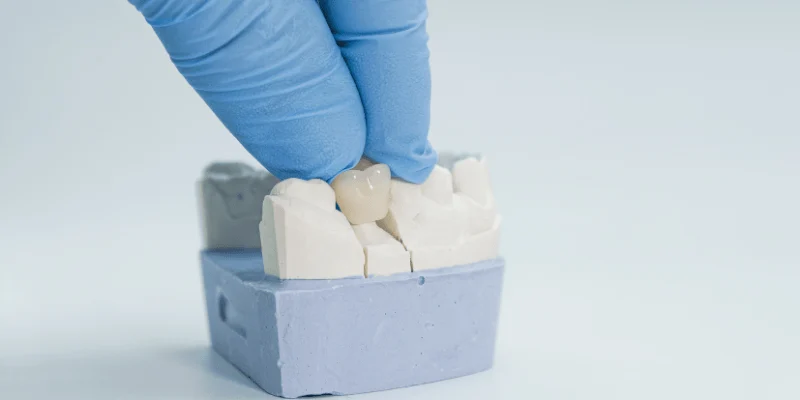
Implant crowns attach to titanium posts placed in your jawbone, while natural tooth crowns fit over your remaining tooth structure. The crowns themselves can be made from identical materials and look virtually the same.
Crown Material Options:
- Porcelain-fused-to-metal: Strong but may show a metal line at the gum
- All-ceramic or all-porcelain: Most natural-looking with excellent color matching
- Zirconia: Very strong and tooth-colored, ideal for back teeth
The main aesthetic difference isn’t the crown itself but how it meets your gums. Natural teeth have gum tissue that’s supported by the tooth root and periodontal ligament. Implant restorations rely on the surrounding bone and soft tissue, which can sometimes result in subtle differences in gum contour.
Your dentist can address these differences through careful planning and sometimes additional procedures to build up gum tissue around implants.
Tooth Replacement Solutions
You have several tooth replacement options beyond single implants. Bridges use adjacent teeth as anchors to replace missing teeth. Dentures replace multiple or all teeth and can be removable or implant-supported.
Different tooth replacement solutions vary in how natural they look and feel. Fixed implant restorations typically provide the most natural appearance because they emerge from your gums like natural teeth.
Removable dentures have improved significantly but may still have visible clasps or a less natural gum-line appearance. Implant-supported dentures eliminate these issues by securing firmly without clasps. The best choice for you depends on how many teeth need replacement, your bone density, and your budget for treatment.
Treatment Planning and Patient Considerations
Deciding between saving a tooth and placing an implant requires careful evaluation of your specific situation, including the tooth’s condition, bone health, and long-term goals. The right choice depends on multiple factors that your dentist will assess during treatment planning decisions.
Choosing Between Natural Tooth Preservation and Implants
Your dentist will first evaluate whether your tooth can be saved with treatments like root canals, crowns, or periodontal therapy. Preserving your natural tooth should be the first option when possible because it maintains the periodontal ligament that provides sensory feedback and bone support.
However, replacing a compromised tooth with an implant becomes necessary when the tooth has severe decay, fractures below the gum line, or advanced bone loss. Your dentist looks for at least 1.5 to 2 mm of healthy tooth structure above the gum line (called the ferrule) to determine if saving the tooth is realistic.
The guiding principle in modern dentistry is to replace only what cannot be predictably preserved. If your tooth has a poor long-term outlook, an implant may offer better stability and function over time.
Assessment and Individual Factors
Your dentist considers several key factors when creating your treatment plan. These include your overall health, oral hygiene habits, smoking status, and any conditions like diabetes that affect healing.
Patient factors evaluated:
- Medical history and medications
- Bone quality and quantity at the implant site
- Gum health and history of periodontal disease
- Ability to maintain proper oral hygiene
- Budget and time commitment
The condition of your tooth matters significantly. Your dentist will assess remaining tooth structure, root stability, and whether previous treatments like root canals have succeeded or failed. They’ll also examine the surrounding bone through X-rays or 3D scans to determine if you have enough bone to support an implant without grafting.
Benefits of Dental Implants
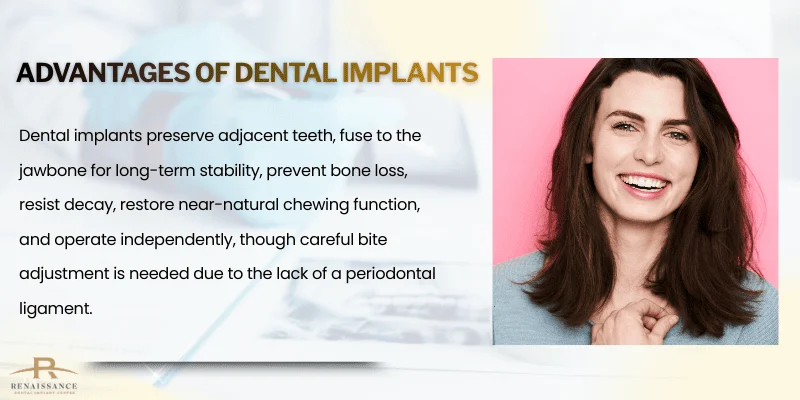
Dental implants offer several advantages when tooth preservation isn’t possible. They don’t require grinding down adjacent healthy teeth like bridges do, which preserves more of your natural tooth structure.
Implants fuse directly to your jawbone through a process called osseointegration, creating a stable foundation that can last 10 to 15 years or longer with proper care. The implant post supports an abutment, which connects to your replacement crown and provides reliable chewing function.
Key advantages include:
- No risk of tooth decay (though gum disease can still occur)
- Prevents bone loss in the jaw
- Functions independently without affecting neighboring teeth
- Restores chewing ability close to natural teeth
Unlike natural teeth, implants don’t have the periodontal ligament that provides tactile feedback, so your dentist will carefully adjust your bite to prevent excessive force on the implant and abutment connection.
Frequently Asked Questions
Dental implants and natural teeth each have unique characteristics that affect your daily life and long-term oral health. Understanding the differences helps you make informed decisions about tooth replacement options.
What are the long-term benefits of dental implants compared to natural teeth?
Dental implants can last 10 to 15 years or longer with proper care. They don’t develop cavities like natural teeth do, which eliminates the risk of tooth decay in the implant itself.
Dental implants help preserve your jawbone by stimulating bone growth when you chew. This keeps your facial structure intact over time. Natural teeth also stimulate bone through their roots, but if you lose a tooth, the bone in that area starts to deteriorate.
Your natural teeth can last a lifetime with good oral hygiene. However, they remain vulnerable to decay, gum disease, and fractures. Implants avoid these specific problems but come with their own risks like peri-implantitis, which is inflammation around the implant site.
What factors should be considered when deciding between dental implants and preserving natural teeth?
Your dentist will look at several factors before recommending treatment. The amount of healthy tooth structure remaining matters greatly. If your tooth has at least 1.5 to 2 mm of solid tooth structure above the gum line, saving it might be the better choice.
Bone health around the tooth plays a major role. If you have advanced gum disease with significant bone loss, an implant might provide better long-term stability.
Your overall oral hygiene habits and ability to maintain the restoration matter too. Both options require consistent care and regular dental visits. Your dentist will also consider the cost, your age, and whether you have any medical conditions that could affect healing.
How do dental implants compare to natural teeth in terms of functionality and appearance?
Modern dental implants look very natural and can closely match the color and shape of your surrounding teeth. Advanced materials and techniques make it difficult for others to tell the difference between an implant crown and a natural tooth.
When it comes to chewing, implants restore most of your biting force. You can eat most foods comfortably. However, implants are rigidly fixed to your bone, while natural teeth have slight movement that helps absorb shock.
Natural teeth have a periodontal ligament that allows them to move slightly and sense pressure. This gives you better feedback about how hard you’re biting. Implants lack this ligament, so they provide less sensory information.
What are the common concerns or drawbacks associated with getting dental implants?
The upfront cost of dental implants is higher than other tooth replacement options. You’ll need surgery to place the implant, which requires healing time before the final crown is attached.
Peri-implantitis is a serious concern that can develop around implants. This inflammatory condition causes bone loss and can lead to implant failure if not caught early. It’s similar to gum disease around natural teeth but can be harder to treat.
Mechanical problems can occur with implants. The screw that holds the crown to the implant can loosen over time. The crown itself might chip or break, just like a crown on a natural tooth.
Some people aren’t good candidates for implants. You need adequate bone density and volume to support the implant. Certain medical conditions or medications can affect how well the implant integrates with your bone.
Can dental implants provide the same sensation and experience as natural teeth?
Dental implants feel different from natural teeth when you bite down. Natural teeth have nerves that detect pressure, temperature, and texture, giving you detailed feedback about what you’re eating.
Implants don’t have these nerves. They connect directly to your bone without the periodontal ligament that provides sensory information. This means you have less ability to feel exactly how much force you’re using when you chew.
Most people adapt to this difference over time. You learn to adjust your chewing patterns. The implant still feels stable and secure in your mouth.
Implants don’t slip or click when you talk, laugh, or eat, unlike removable dentures. This stability makes them feel more like your original teeth in daily activities.
How does the maintenance and care for dental implants differ from that of natural teeth?
You need to brush and floss around your implants just like you do with natural teeth. Plaque buildup can cause inflammation and infection around the implant. Daily cleaning removes bacteria and keeps the surrounding gums healthy.
Regular dental checkups are essential for both implants and natural teeth. Your dentist will check the bone levels around your implants using X-rays. They’ll also measure the depth of the space between the implant and your gum tissue to watch for signs of problems.
Implants require some special care techniques. Your dentist might recommend specific cleaning tools that won’t scratch the implant surface. Metal instruments can damage titanium or zirconia implants during professional cleanings.
You should visit your dentist every three to six months if you have risk factors like a history of gum disease. Even with implants, you’re not free from maintenance requirements. Implants are not maintenance-free and need ongoing professional care to last as long as possible.