


Tooth loss is common among older Americans – roughly 52% of U.S. adults have lost at least one tooth. Restoring function and esthetics typically involves one of several major prosthetic options: dental implants, partial or full dentures, fixed bridges, or “All-on-4” implant‐supported prostheses.
These modalities vary widely in cost, longevity, and patient uptake. In recent decades, implant-based treatments have grown in popularity, while traditional dentures and bridges still serve millions, especially among older and disadvantaged patients.
This guide reviews recent data (last 5 years) on how often each method is used, who uses them, and their comparative long-term success. We highlight demographic factors influencing adoption and compare national averages to Louisiana (especially Jefferson Parish/Metairie) where oral health is relatively poor.
Forecasts beyond 2026 (based on epidemiologic models) are also discussed.
Replacement Options: Characteristics and Context
- Dental implants (endosseous implants). Titanium screw fixtures placed in jaw bone to support single crowns, bridges, or full-arch prostheses. Implants preserve adjacent teeth and bone, with excellent function and aesthetics.
Implant usage has risen sharply: in 1999–2000 about 0.7% of U.S. adults (with missing teeth) had implants, climbing to 5.7% by 2015–2016 (roughly 6% overall, since only those missing ≥1 tooth are eligible).
Higher implant prevalence has been seen among older adults (esp. ages 55–74) and among those with private insurance or more education.
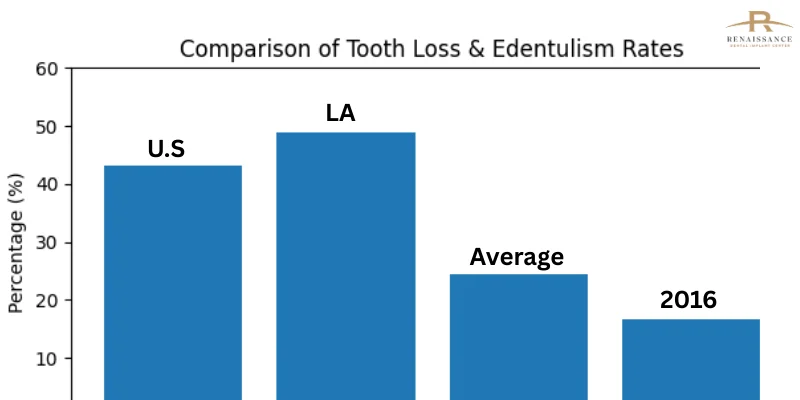
Insurance disparities are stark: public programs (Medicare/Medicaid) generally do not cover implants, so socioeconomically advantaged groups far outpace others in implant uptake. - Removable dentures (partials and complete). Dentures are much more common overall, especially among seniors and the poor. In 2016, 16.7% of Louisiana seniors (age 65–74) had lost all natural teeth (the national target was <21.6% by 2020, per Healthy People objectives).
Nationwide, NHIS data show 19–30% of U.S. seniors (65+) are completely edentulous (no natural teeth). In Louisiana, nearly half of adults (48.9%) had lost at least one permanent tooth due to decay or disease, vs 43.1% nationally, indicating high denture demand.
Importantly, edentulism has been declining for decades: it fell from ~19% in 1957–58 to ~4.9% by 2009–2012. Projections suggest complete edentulism will drop to ~2.6% by 2050 (still millions of people).
Nevertheless, partial dentures (for people with some remaining teeth) remain a mainstay, and conventional removable complete dentures still serve millions of older adults. However, dentures require ongoing maintenance and often need relining or repair every few years.
Systematic reviews find that approximately 88–95% of new complete dentures survive 5 years without major failure (mean lifespan ~8–10 years). Many denture wearers report discomfort or dietary limitations if fit is poor, especially among low-income patients. - Fixed dental bridges (tooth-supported). Traditional bridges use adjacent natural teeth as anchors. They do not require implants but do sacrifice or cover healthy tooth structure.
High-quality tooth-supported metal-ceramic (PFM) bridges have very high 5-year success: pooled analyses show ~99.5% survival at 5 years for PFM multiple-unit bridges (all-ceramic bridges slightly lower, ~92%).
Like implants, bridge success is higher in well‐controlled clinical settings, but bridges depend on patient oral hygiene and can fail if abutment teeth decay or break. Bridges remain widely used when implants are contraindicated or for patients with adequate dentition, especially in middle-aged and older adults.

- All-on-4 (full-arch implant‐supported prosthesis). All-on-4 is a specific implant technique: typically four implants are placed in an edentulous jaw (often tilted for maxilla) to support a fixed full-arch “hybrid” denture.
It addresses complete tooth loss with one prosthesis. All-on-4 has grown rapidly in the past decade as a more affordable (than 6+ implants) solution for edentulous jaws. Published long-term data (mostly from European clinics) show All-on-4 implant survival of roughly 93–96% even up to 10–18 years.
For example, one Portuguese study (471 patients) reported 93% cumulative implant survival and 98.8% prosthesis survival over 10–18 years. Mechanical complications (screw loosening, veneering cracks) are common (often >30% of cases).
All-on-4 is appealing for full-arch replacement, but due to cost it remains a minority share of the market. (We have no national prevalence; it falls under the broad “implant” category but is treated here as a distinct approach.)
Compare implants, bridges, and dentures using real data relevant to Metairie, LA patients.
Utilization Trends and Demographics
Implant uptake (national). Recent NHANES analyses show implant use has surged. In 1999–2000 just 0.7% of US adults had implants, but by 2015–2016 it reached 5.7%.
This rise (∼14% relative increase per year on average) is most dramatic in older age groups (55–74) and among insured, educated, higher-income patients. For example, in 2015–2016 only ~6% of adults with missing teeth had implants, but projections (based on NHANES trends) suggest 17–23% could have implants by 2026.
If current rates hold, most new implant recipients will be baby‐boomers retiring, but disparities persist: non-White, uninsured, and less-educated adults lag far behind.
Denture use (national). Although edentulism is falling, there remains a large denture-using population. In 2010 about 12.2 million Americans were fully edentulous; every decade adds new seniors. However, the rate of edentulism is projected to halve again by 2050.
Partial tooth loss (1–5 missing teeth) is common across all ages: over 50% of U.S. adults have lost one or more teeth. Thus many hundreds of thousands of new partial dentures are made each year.
National surveys indicate that among seniors (65+), only about two-thirds visit a dentist annually; those who are edentulous are much less likely to seek care. Louisiana has poorer access: just 56.6% of LA adults saw a dentist in the past year, vs 66.4% nationally.
Bridges and other fixed prostheses. Reliable national tracking of tooth-supported bridges is scarce. Overall, the relative popularity of bridges versus implants depends on dentist preference and patient factors.
A declining trend in edentulism has increased the pool of patients eligible for bridges or implants. Industry analysts report rising market demand for fixed implant prostheses (including bridges on implants), consistent with increasing implant placement.
However, high-quality tooth-supported bridges remain a standard replacement for 1–2 missing teeth, with insurance often covering them similarly to crowns.
All-on-4 and full-arch trends. All-on-4 (and similar “All-on-X”) treatments have expanded rapidly in implant practices. U.S. implant manufacturers note year-over-year growth in full-arch fixed solutions.
Precise adoption rates are unknown; however, long-term clinical studies show that despite a roughly 93–98% implant/prosthesis survival at 5–10+ years, mechanical and biological complications are common.
For example, Maló et al. found prosthesis survival ~98.8% at 10–18 years, but implant failures (~7%) and connector/screw issues occurred. Thus All-on-4 is seen as effective but costly, typically used in specialized centers.
Demographic influences. In general, tooth replacement reflects underlying oral health disparities. Disadvantaged groups suffer more tooth loss and have less restorative care.
For instance, Louisiana’s data show Medicaid-enrolled adults had much higher tooth extraction rates than privately insured. As a result, they more often rely on dentures (which Medicaid does cover) and seldom get implants.
Rural areas like much of Louisiana (especially outside New Orleans/Jefferson) face dentist shortages. A 2018 Louisiana report noted the state had a severe rural dentist deficit (projected need +338 dentists by 2025), which likely limits access to advanced treatments.
Jefferson Parish/Metairie itself is suburban and relatively well-served by dentists, but its population is older (median age ~40, higher than U.S.) and includes lower-income areas, mirroring the state’s lagging oral health.
Overall, geography and insurance are key drivers: coastal/mountain regions in the US have lower edentulism, whereas the Southeast (Mississippi Delta/Appalachia, including Louisiana) shows persistently high tooth loss rates.
The high rate of tooth loss and low dental visit rate in Louisiana suggest Metairie patients may underutilize advanced replacements relative to national norms.
Review tooth replacement statistics US patients rely on to compare implants, dentures, and bridges.
Comparative Survival and Failure Rates
Replacement options also differ in longevity and failure profiles. In general, fixed prostheses (bridges or implants) outlast removable dentures.
- Implants/bridges have very high survival: 90–96%+ at 5 years. Thus implant crowns or bridges generally outlast dentures. However, complications (biologic or mechanical) accumulate over time. Long-term studies show ~90–95% implant survival at 10+ years, and fixed bridges likewise remain intact in ~90% of cases at a decade.
- Removable dentures degrade with time: systematic reviews find only ~88% of new complete dentures survive 5 years without “failure” (meaning needing replacement). By 10 years ~60% have failed. Common problems include acrylic base fractures and loss of retention due to bone loss.
Many denture wearers endure ill-fitting dentures for years. RPDs (partial dentures) often need more repairs because clasps stress the metal and abutment teeth. - All-on-4: survival is comparable to other implant-supported options, but complications are significant. One review found ≥30% of All-on-4 patients had mechanical prosthetic issues within 3–5 years.
Implant loss in All-on-4 is slightly higher (some studies 5–7% by 5–10 years) than single implants, possibly due to immediate loading.
Dentures remain important for people who cannot afford or tolerate implants. It is also notable that some dentures are now implant-retained overdentures (e.g. 2 implants supporting a lower denture), but these still rely on dentures for chewing stability; analysis of those is beyond scope here.
Regional Comparison: Jefferson Parish / Metairie vs National
Louisiana’s oral health context: Louisiana ranks near the bottom nationally for dental health. A 2018 state assessment reported only 56.6% of Louisiana adults had a dental visit in the past year (vs 66.4% nationally).
Nearly half of Louisiana adults had lost at least one tooth, and 16.7% of LA seniors were completely edentulous (compared to higher targets). Jefferson Parish (where Metairie is) shares these challenges: it has a large elderly population (median age ~40) and significant low-income and uninsured residents.
Statewide, rural dentist shortages and low Medicaid reimbursement mean that many poor seniors lose teeth rather than getting restorative work.
Comparing to U.S. averages: Nationally, only 43.1% of adults reported losing ≥1 tooth (vs 48.9% in LA). Older Americans overall have better dental retention than Louisiana seniors (US seniors ≈19–30% edentulous, LA seniors ~16.7% edentulous as of 2016, reflecting some urban advantage but also legacy effects of poverty).
Implant utilization in Louisiana is likely below the national trend, given lower insurance coverage and access. There are no public data on Jefferson‐specific implant rates, but low overall dental visit rates suggest underutilization.
Implications for Metairie area: Dentists in Metairie serve a mixed urban-suburban population. While Metairie has many specialists, the overall demand follows state patterns. One local market report noted rising implant demand in New Orleans area, but actual clinical data are lacking.
We infer that Jefferson Parish residents are more likely than average Americans to rely on dentures (especially partials), and less likely to receive implants or bridges, unless they have private insurance.
State programs (e.g. Medicaid dental) cover extractions and dentures, so the partial versus implant/bridge replacement gap probably mirrors income gaps.
Future Outlook (Beyond 2026)
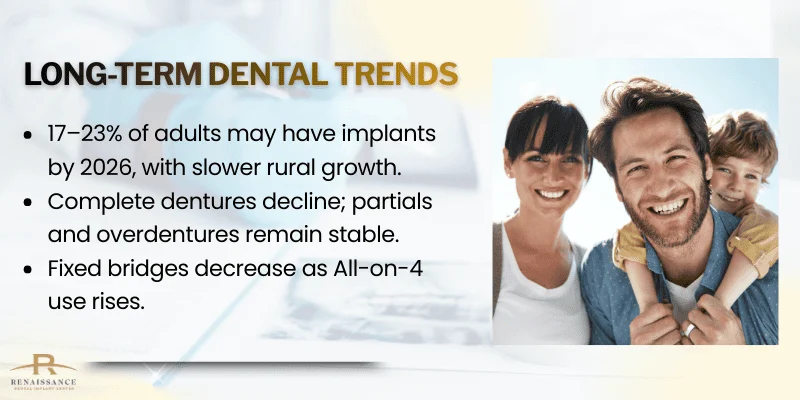
- Implants: If current trends persist, millions more Americans will receive implants in the 2020s. The Harvard NHANES analysis projects that by 2026 17–23% of adults with missing teeth could have implants.
However, because trends may slow (market saturation, patient awareness ceilings), the growth could plateau. Major drivers – the aging population and technological advances (shorter implants, digital planning, lower-cost clinics) – will likely push demand upward.
On the supply side, more dentists are trained in implantology, though many rural areas will still lack providers. - Dentures: Demand for new dentures should decline as edentulism falls. Slade et al.’s model suggests the number of completely edentulous Americans will drop from 12.2M (2010) to ~8.6M by 2050.
Thus manufacturers of complete dentures face a shrinking market, while partial dentures and implant overdentures may hold steadier. In Louisiana, edentulism remains higher than national, so some denture need persists, but likely diminishing in the long run.
Denture technology (e.g. 3D-printed bases) may improve cost-effectiveness, but dentures remain lower-tech than implants. - Bridges and All-on-4: As implants become more affordable and patients prefer not to grind down healthy teeth, fixed bridges may see a modest decline.
All-on-4 and similar full-arch implant protocols are expected to grow (with more oral surgeons and prosthodontists offering them), potentially replacing many new denture cases. However, high cost and specialized care mean this growth is gradual. - Regional note: Unless Louisiana expands dental coverage, rural/poor areas like Jefferson Parish may adopt new treatments more slowly than the national curve.
Forecasts must consider policy: e.g. if Medicare begins covering implants (as some health plans partially do), adoption could jump. Conversely, if Medicaid remains limited to dentures, many low-income seniors will still rely on removable prostheses.
Summary
Across the U.S., tooth replacement is moving toward fixed, implant-based solutions. Dental implants now benefit a growing minority of patients, with prevalence in missing-tooth adults rising from <1% in 2000 to ~6% in 2016, projected to perhaps 20% by 2026.
In contrast, reliance on removable dentures is slowly waning, as the proportion of completely edentulous adults declines (projected ~2.6% by 2050).
However, dentures and partial dentures still serve many, especially among older, low-income groups. Fixed bridges (tooth-supported) remain highly successful, though their use is partially supplanted by implants. Failure/survival data reinforce that implants and bridges outperform dentures over 5+ years.
Demographically, implant adoption is strongly skewed toward wealthier, insured, and better-educated patients, whereas disadvantaged populations (including many in Louisiana/Jefferson Parish) continue to experience high tooth loss and rely on dentures.
Jefferson Parish’s statistics track the state’s poor oral health indicators: for example, nearly half of adults there have lost permanent teeth, well above the national 43% average.
Clinically, these trends imply a shifting landscape: dentists must be prepared for growing implant demand, while continuing to manage denture care for the aging population.
Public health policy must address the widening gap in access; for instance, expanding insurance coverage for implants or preventive care could alter future adoption patterns.
Finally, ongoing monitoring (through surveys like NHANES or state health assessments) will be needed to update these projections beyond 2026 and to ensure that all populations benefit from advances in tooth-replacement technology.