


Most people worry about the visible gap when they lose a tooth, but the real problem starts underneath. When you lose a tooth, your jawbone begins to break down and shrink because it no longer receives the pressure and stimulation it needs from chewing.
This process can start within just a few months and continue for years if left untreated.
Bone loss after tooth extraction affects more than just your mouth. It can change the shape of your face, make your remaining teeth shift out of place, and create problems with eating and speaking. The longer you wait to address a missing tooth, the harder it becomes to fix these issues.
Understanding what happens beneath your gums after tooth loss helps you make better decisions about your dental health. The good news is that you have options to prevent or reverse bone loss, and taking action early makes a big difference in protecting your smile and overall health.
Key Takeaways
- Your jawbone starts to deteriorate within months after losing a tooth because it lacks stimulation from chewing
- Bone resorption after tooth loss can change your facial appearance and make remaining teeth shift
- Dental implants and bone grafting procedures can prevent or reverse jawbone deterioration
Learn what happens after tooth loss and explore treatment options in Metairie, LA.
Immediate Changes Below the Gums After Tooth Loss
When you lose a tooth, your body starts a complex healing process right away. The empty socket begins to close up, but at the same time, the bone and tissue that once supported your tooth start to break down.
How the Extraction Site Heals
After a tooth extraction, your body works quickly to protect the empty socket. A blood clot forms within the first 24 hours to seal the area and prevent infection. This clot acts as a protective barrier while new tissue grows underneath.
Over the next few weeks, soft tissue called granulation tissue fills in the socket. Your gums gradually close over the extraction site, usually within 1-2 weeks. While this surface healing looks complete, changes continue to occur beneath the gum line that aren’t visible.
The socket itself takes several months to fill in completely with new bone. However, this new bone is different from what was there before. It’s often less dense and smaller in volume than the original bone structure.
The Onset of Bone Resorption
Without a tooth root to stimulate it, your jawbone begins to shrink. This process is called bone resorption, and it starts within just a few weeks of tooth loss.
Your jawbone needs the pressure and movement from chewing to stay healthy. When a tooth is missing, that stimulation disappears. Your body sees the bone as unnecessary and starts breaking it down. The bone cells that build new bone slow down, while the cells that break down bone speed up.
Bone resorption affects both the height and width of your jawbone. You can lose up to 25% of bone width in the first year alone. This loss continues over time, though it slows down after the first few months.
Alveolar Bone Changes
The alveolar bone is the part of your jaw that holds your tooth roots. When you lose a tooth, this bone goes through significant changes.
The socket walls begin to collapse inward as healing occurs. The bone shrinks both vertically and horizontally, creating an indentation where your tooth used to be. This shrinkage happens because the alveolar bone exists specifically to support teeth.
Key alveolar bone changes include:
- Loss of bone height (vertical dimension)
- Loss of bone width (horizontal dimension)
- Decreased bone density in the area
- Changes to the shape of your jaw ridge
These changes can affect your remaining teeth. The gum line may recede, and neighboring teeth can shift position. The bone loss doesn’t stop at the extraction site either; it can spread to adjacent areas over time.
Protect your jawbone health with expert tooth replacement care in Metairie, LA.
Why Bone Loss Occurs and How It Progresses
When you lose a tooth, your jawbone no longer receives the pressure it needs to stay healthy. This lack of stimulation triggers a process where bone cells break down faster than they rebuild, leading to progressive deterioration that can affect your oral health and facial structure.
Role of Jawbone Stimulation
Your jaw bone stays strong through constant use. Every time you chew, bite, or even talk, your teeth send pressure signals through their roots into the surrounding bone. This stimulation tells special cells called osteoblasts to create new bone tissue.
When bone loss occurs, cells called osteoclasts start breaking down bone to use elsewhere in your body. Without teeth to provide pressure, your body sees the jawbone as unnecessary and begins reabsorbing it.
The titanium posts in dental implants work because they mimic natural tooth roots and restore this needed stimulation.
Think of it like muscle loss when you stop exercising. Your jaw bone needs regular activity to maintain its density and volume.
Timeline of Bone Deterioration
Bone loss after tooth loss doesn’t happen all at once. It follows a predictable pattern that speeds up over time.
In the first year after losing a tooth, you can lose up to 25% of your jawbone width in that area. The deterioration continues at a slower but steady pace after that. Within three to five years, significant bone volume disappears.
The front lower jaw typically loses bone faster than other areas. This can cause your facial appearance to change, making you look older as your jaw shrinks. The bone loss also makes it harder to fit dentures properly since the ridge that supports them gradually flattens out.
Factors That Accelerate Bone Loss
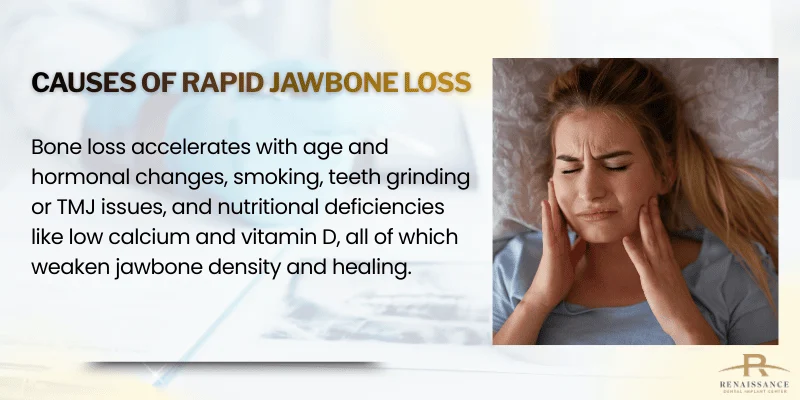
Several conditions speed up bone deterioration beyond normal tooth loss.
Age and hormones play a major role. Women after menopause face higher risk because lower estrogen levels affect bone density throughout the body, including the jaw.
Smoking ranks as one of the biggest risk factors. It reduces blood flow to your gums and decreases your body’s ability to heal and rebuild bone tissue.
Grinding your teeth (bruxism) creates abnormal pressure that stresses your jawbone and can trigger bone resorption. TMJ disorder causes similar problems when your jaw joints don’t align properly.
Nutritional deficiencies matter too. Your bones need calcium and vitamin D to stay strong. Without enough of these nutrients, your jawbone health suffers along with the rest of your skeleton.
How Gum Disease Impacts Bone
Periodontal disease causes bone loss in a different but equally damaging way. Bacteria that cause gum infections don’t just attack your soft tissue. They also destroy the bone surrounding your teeth and the periodontal ligaments that hold teeth in place.
The infection creates pockets between your teeth and gums where more bacteria collect. As the disease progresses through its stages, bone loss becomes more significant in the advanced phases.
Your immune system’s response to the chronic infection actually contributes to the problem. The inflammation meant to fight bacteria also breaks down bone tissue. Without treatment, this combination of bacterial damage and immune response leads to tooth loss, which then triggers the additional bone loss from lack of stimulation.
Explore treatment options to restore your smile and oral health.
Consequences of Unaddressed Bone Loss
When bone loss goes untreated, it creates a cascade of problems that affect both your appearance and dental function. The jawbone continues to shrink over time, leading to facial changes, tooth movement, and complications with restorative options.
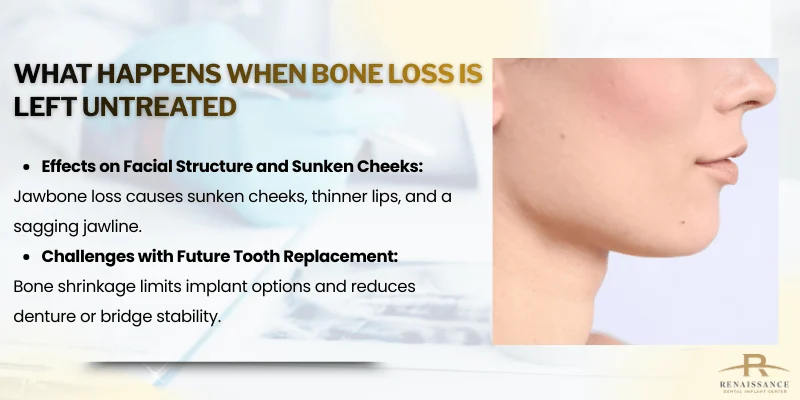
Effects on Facial Structure and Sunken Cheeks
Your jawbone provides crucial support for your facial muscles and skin. When the bone deteriorates after tooth loss, this support disappears and your face begins to change shape.
The alveolar bone that once held your teeth in place starts to shrink, causing your lower face to collapse inward. This creates sunken cheeks and a hollow appearance around your mouth. Your lips may look thinner and your chin can appear closer to your nose.
The changes become more noticeable over time. In the first year after losing a tooth, you can lose up to 25% of the bone volume in that area. The bone continues to deteriorate year after year, making you look older than your actual age.
Your facial profile changes too. The lower third of your face shortens, creating wrinkles around your mouth and a sagging jawline.
Shifting and Bite Issues
Missing teeth create empty spaces that neighboring teeth try to fill. Your remaining teeth gradually drift toward the gaps, tilting and rotating out of their proper positions.
This movement throws off your bite alignment. Your upper and lower teeth no longer meet correctly when you chew or close your mouth. The misalignment can place excessive stress on certain teeth, causing them to wear down unevenly or crack under pressure.
You might notice difficulty chewing certain foods. Hard or chewy items become challenging to eat, and you may start avoiding them altogether. Some people develop jaw pain or clicking sounds when they open and close their mouth.
The shifting teeth can also create new gaps and spaces throughout your mouth, trapping food particles and making it harder to keep your teeth clean.
Challenges with Future Tooth Replacement
Bone loss significantly complicates your options for replacing missing teeth. Dental implants require adequate bone density and volume to anchor securely in your jaw. Without sufficient bone, implants cannot be placed until you undergo bone grafting procedures first.
A dental bridge relies on neighboring teeth for support, but if bone loss has weakened these teeth, they may not be strong enough to hold the bridge. The procedure becomes riskier and less predictable.
Dentures face their own problems with bone loss. As your jawbone shrinks, dentures become loose and ill-fitting. Traditional removable dentures don’t stimulate the bone like natural teeth do, so the bone continues to deteriorate underneath them.
You’ll need frequent adjustments and replacements as your jaw shape changes. Loose dentures can slip when you eat or speak, causing embarrassment and discomfort. The lack of stability makes eating difficult and limits your food choices.
Prevention and Early Intervention Strategies
Taking action early can protect your jawbone and keep your smile healthy for years to come. Dental implants placed soon after tooth loss, good daily care habits, and quick treatment for gum problems all work together to stop bone loss before it starts.
Importance of Early Implant Placement
When you lose a tooth, your jawbone starts to shrink within just a few months. Getting a dental implant placed early helps prevent this bone loss by giving your jaw the stimulation it needs to stay strong.
Dentists recommend placing implants within three to six months after tooth extraction. This timing lets your gum tissue heal while your bone is still thick and healthy. Waiting too long makes the procedure harder because you might need a bone graft first.
Early implant placement keeps your other teeth from shifting into the empty space. It also maintains the natural shape of your face and jaw. The implant works like a natural tooth root, sending signals through your bone that tell your body to keep building new bone tissue.
If you’ve already waited months or years, you can still get implants. But acting quickly saves you time, money, and extra procedures.
Role of Oral Hygiene and Regular Dental Visits

Brushing twice daily and flossing remove the sticky film of bacteria that causes gum disease. This daily routine keeps your gums healthy and your jawbone protected from infection.
Regular dental visits every six months catch problems before they get serious. Your dentist can spot early signs of gum disease and clean areas you might miss at home. Professional cleanings remove hardened plaque that your toothbrush can’t reach.
Key oral hygiene habits include:
- Brushing for two minutes twice per day
- Flossing between all teeth daily
- Using an antibacterial mouthwash
- Replacing your toothbrush every three months
- Cleaning your tongue to remove bacteria
Your dentist checks for bone loss during routine visits using X-rays and pocket measurements around your teeth.
Treating Gum Disease Promptly
Gum disease damages the soft tissue around teeth and destroys the bone that holds them in place. Getting treatment right away stops this damage from getting worse.
Early-stage gum disease called gingivitis can be reversed with better brushing and professional cleanings. But if it advances to periodontitis, you need periodontal therapy to save your teeth and bone. This treatment removes bacteria from deep pockets below your gumline.
Your dentist or periodontist might recommend scaling and root planing as a first step. This deep cleaning smooths your tooth roots and helps your gums reattach. Some cases need surgery to clean infected areas and repair damaged bone.
Don’t ignore warning signs like bleeding gums, bad breath that won’t go away, or teeth that feel loose. These symptoms mean bacteria are already attacking your bone.
Advanced Bone Preservation and Regeneration Treatments
Modern dentistry offers several proven methods to protect and rebuild jawbone after tooth loss. These procedures help maintain bone density and create a strong foundation for future tooth replacements.
Socket and Ridge Preservation Techniques
When your dentist or oral surgeon extracts a tooth, they can immediately fill the empty socket with special materials to prevent bone loss. This process, called socket preservation, keeps the bone from shrinking during the healing period.
Ridge preservation works similarly by maintaining the shape and volume of your jawbone ridge. Your dentist places bone graft material into the extraction site and covers it with a protective membrane. This creates a barrier that keeps gum tissue from growing into the space where bone should form.
These techniques are especially helpful if you plan to get dental implants later. The preserved bone provides a stable base for the implant without needing additional procedures. Most ridge preservation treatments heal within three to four months, and you can usually go about your normal activities within a few days.
Bone Grafting and Bone Regeneration
Bone grafting uses small pieces of bone material to rebuild areas where bone has been lost. Your periodontist or oral surgeon can use bone from your own body, synthetic materials, or donated bone from a tissue bank.
The graft serves as a framework that encourages your natural bone to grow back. Over time, your body replaces the graft material with your own healthy bone. This process, called bone regeneration, typically takes several months to complete.
Advanced bone regeneration techniques now include growth factors and platelet-rich plasma therapy to speed up healing. Some procedures combine bone grafting with guided tissue regeneration, where your dentist places a thin membrane between the bone and gum to direct proper healing.
Sinus Lift and Ridge Augmentation Options
A sinus lift adds bone to your upper jaw between your molars and premolars. Your oral surgeon gently lifts the sinus membrane and places bone graft material underneath. This creates enough bone height for dental implants in the upper back teeth area.
Ridge augmentation rebuilds the width and height of your jawbone when it has become too thin or short. Your surgeon places bone graft material along the ridge of your jaw, then covers it with tissue or a membrane. This procedure restores your jaw to its original form after tooth loss or gum disease.
Both procedures require several months of healing before you can move forward with dental implants. Your dentist will monitor your progress with X-rays to make sure the bone is growing properly.
Long-Term Management and Solutions for Missing Teeth
Replacing missing teeth involves weighing different options that range from permanent implants to removable appliances, each offering distinct benefits for bone preservation and daily function.
Choosing Dental Implants
Dental implants stand out as the most effective long-term solution for tooth replacement. These titanium posts are surgically placed into your jawbone, where they fuse with the bone tissue through a process called osseointegration.
Unlike other replacement options, dental implants prevent bone loss by mimicking natural tooth roots. When you chew, the implant transfers force into your jawbone, which keeps the bone active and healthy. This stimulation signals your body to maintain bone density instead of breaking it down.
The implant procedure typically happens in stages. First, your dentist places the implant post into your jaw. After several months of healing, they attach an abutment and crown. The entire process can take three to six months, but the result is a permanent tooth that functions like your natural teeth.
Benefits of dental implants include:
- No damage to adjacent teeth
- Natural appearance and feel
- No special cleaning requirements beyond regular brushing
- Success rates above 95% with proper care
Comparing Implants, Bridges, and Dentures
Your tooth replacement options vary in cost, durability, and impact on your oral health. Each option serves different needs depending on how many teeth you need to replace and your budget.
A dental bridge can reduce the risk of bone resorption when used to replace missing teeth, though it doesn’t stop it completely. Bridges require grinding down healthy neighboring teeth to serve as anchors. They typically last 10-15 years before needing replacement.
Dentures are removable appliances that replace multiple missing teeth. They cost less upfront but don’t prevent jawbone deterioration. You’ll need adjustments every few years as your jaw changes shape.
| Option | Bone Preservation | Lifespan | Affects Other Teeth |
| Dental Implant | Yes | 20+ years | No |
| Dental Bridge | Minimal | 10-15 years | Yes |
| Dentures | No | 5-10 years | No |
Supporting Overall Jawbone Health
Your jawbone health depends on consistent stimulation and good oral hygiene practices. Even with tooth replacements, you need to maintain the surrounding tissues.
Regular dental checkups help catch bone loss early. Your dentist can monitor bone levels through X-rays and recommend interventions if needed. Professional cleanings every six months remove plaque and bacteria that contribute to gum disease, which is a leading cause of bone deterioration.
If you already have bone loss, bone grafting procedures can rebuild the foundation needed for implants. These procedures add bone material to weakened areas, creating a stable base for future restoration.
Your diet also plays a role in maintaining strong bones. Calcium and vitamin D support bone density throughout your body, including your jaw. Avoiding tobacco products helps too, since smoking interferes with bone healing and increases your risk of implant failure.
Frequently Asked Questions
Tooth loss triggers several changes beneath your gums that many people don’t expect. These changes can affect everything from bone density to your ability to get dental implants later.
How does losing a tooth affect the health of your gums?
When you lose a tooth, your gums lose their natural shape and support. The gum tissue that surrounded the tooth starts to recede and flatten over the empty space.
Without a tooth root to hold it in place, the gum tissue becomes thinner. This makes the area more vulnerable to infection and irritation from food particles.
Your gums may also change color in the area where the tooth was lost. They can appear paler or less pink than the gums around your other teeth.
The surrounding teeth can shift into the empty space, which changes how your gums fit around them. This creates new gaps where bacteria can collect and cause gum disease.
What are the changes in the jawbone after a tooth extraction?
Your jawbone starts to shrink after tooth extraction because it stops getting stimulation from chewing. The bone in that area no longer receives signals that it’s needed.
You can lose up to 25% of bone width in the first year after losing a tooth. The height of the bone also decreases, though usually more slowly than the width.
Bone loss continues after the first year at a rate of about 0.5% of density each year. The longer you wait to replace a missing tooth, the more bone you lose.
The bone becomes thinner and weaker through a process called bone resorption. Your body breaks down the bone tissue and moves the minerals to other parts of your body.
Can the gums heal after a tooth has been removed, and how?
Your gums do heal after a tooth extraction, but they don’t grow back to their original state. The soft tissue quickly closes over the space left by the tooth to protect the bone underneath.
Most people’s gums heal enough within 1 to 2 weeks for normal activities. Complete healing of the gum tissue takes longer, usually several months.
A blood clot forms in the socket right after extraction. This clot is essential for healing because it protects the bone and allows new tissue to develop.
The gums seal the wound but don’t replace the height and shape they had when the tooth was present. The healed gum tissue sits lower and flatter than before the extraction.
What are the risks of not replacing a missing tooth?
Your other teeth shift into the empty space when you don’t replace a missing tooth. The teeth next to the gap tilt toward it, and the tooth opposite it can grow into the space.
This movement creates new gaps between your teeth where food gets trapped. Your bite changes, which can make chewing harder and less efficient.
Bone loss accelerates when teeth remain missing, making future dental work more complicated. You may need bone grafting before you can get an implant if you wait too long.
Your face shape can change as the jawbone shrinks. The lower part of your face may look shorter, and you can develop a sunken appearance around your mouth and cheeks.
The remaining teeth take on extra pressure from chewing, which can wear them down faster. This increases your risk of breaking or losing more teeth.
What treatment options are available for preserving gum health post-tooth loss?
Socket preservation is one of the best ways to protect your gums and bone after extraction. Your dentist fills the empty socket with bone graft material right after removing the tooth.
Dental implants are the only tooth replacement that prevents ongoing bone and gum loss. The implant post stimulates the jawbone like a natural tooth root, which keeps the surrounding tissue healthy.
Bone grafting helps maintain the bone structure that supports your gums. Your dentist can use bone from your own body, donor bone, animal-derived products, or synthetic materials.
Good oral hygiene protects the extraction site and surrounding gums. Gently rinse with warm salt water after 24 hours and brush carefully around the area.
Ridge augmentation rebuilds the width and height of the jawbone and gum tissue. This creates a stable foundation if you plan to get dental implants or other restorations later.
How can leaving a tooth root in the gum impact oral health?
A tooth root left in your gum after extraction can cause infection if bacteria enter the area. The root fragment can prevent proper healing of the surrounding tissue.
Your gums may not close properly over the socket if a root piece remains. This creates a space where food and bacteria collect, leading to pain and swelling.
The bone around a leftover root fragment may not heal correctly. This can make it harder to place a dental implant in that spot later.
Some root fragments are small and don’t cause problems. Dentists sometimes leave tiny pieces that are difficult to remove if they’re not causing issues.
You should contact your dentist if you notice pain, swelling, or drainage from an extraction site. These signs might mean a root fragment is causing complications that need treatment.