


Your jawbone’s density plays a huge role in whether your dental implants stay strong for years or face problems down the road. When you get a dental implant, it needs solid bone to hold it in place, just like a fence post needs firm ground to stay upright.
Bone density directly determines how well your implant anchors into your jaw, affecting both immediate stability and long-term durability.
Research shows that when bone density drops below certain levels, implants can lose up to 58% of their stability.
Low bone density means your implant might move more than it should, which can lead to failure over time. The good news is that you have options even if your bone density isn’t ideal.
Understanding how bone density affects your eligibility for implants helps you make better choices about your treatment. Dentists can test your bone quality before placing implants and suggest ways to improve it if needed.
Key Takeaways
- Strong bone density provides the foundation that keeps dental implants stable and secure for many years
- Dentists can measure your bone quality before implant placement and recommend treatments like bone grafting if needed
- Maintaining healthy bones through proper care and lifestyle choices helps protect your implants long after the procedure
Why Bone Density Matters for Implant Strength
The strength of your jawbone directly determines whether a dental implant can hold firm over time. Dense bone provides the solid foundation needed for implants to fuse properly and withstand daily pressure from chewing and biting.
Role of Bone Density in Implant Support
Your jawbone acts like the foundation of a building for dental implants. When you have strong bone density, your implants gain the stability they need to function like natural teeth.
Bone density measures how much mineral content exists in your jawbone. Think of it as the difference between anchoring a post in solid concrete versus loose sand.
Dense bone has more minerals packed tightly together, which creates a stronger structure. When your dentist places an implant, it needs enough dense bone to grip onto.
Without sufficient density, the implant can’t establish a secure hold. Your jawbone must be thick enough and strong enough to support the titanium post that replaces your tooth root.
Low bone density can happen for several reasons. Age, tooth loss, gum disease, and certain medical conditions like osteoporosis all reduce bone strength over time.
Missing teeth also cause bone loss because your jaw needs stimulation from tooth roots to stay healthy.
Connection with Implant Stability and Longevity
The density of your bone determines how well your implant stays in place for years to come. High-quality bone creates long-term implant success by preventing loosening or failure.
Your implants face constant force every time you eat or speak. Dense jawbone can handle these pressures without breaking down.
Weak or thin bone may not withstand daily stress, leading to implant movement or complete failure. Implants placed in dense bone have higher success rates.
The bone essentially grips the implant tightly and keeps it locked in position. Poor bone density increases your risk of complications like:
- Implant loosening over time
- Difficulty healing after surgery
- Complete implant failure
- Need for additional procedures
Your bone quality affects how quickly you heal after implant placement too. Dense bone typically recovers faster and creates stronger bonds with the implant material.
Impact on Osseointegration
Osseointegration is the process where your jawbone fuses directly with the implant surface. This biological bonding determines implant stability and strength for the long haul.
Your bone cells must grow onto and around the implant to create a permanent connection. Dense bone contains more active cells that can attach to the titanium post.
This creates a solid union between natural bone and artificial material. The osseointegration process typically takes three to six months.
During this time, your bone gradually grows into the tiny spaces on the implant surface. Higher bone density speeds up this process and creates stronger bonds.
When bone density is low, osseointegration may fail completely. Your bone might not have enough cells or minerals to grow properly around the implant.
This leaves gaps between the bone and implant, which prevents secure attachment and can lead to implant rejection.
Assessing Bone Density Before and During Implant Procedures
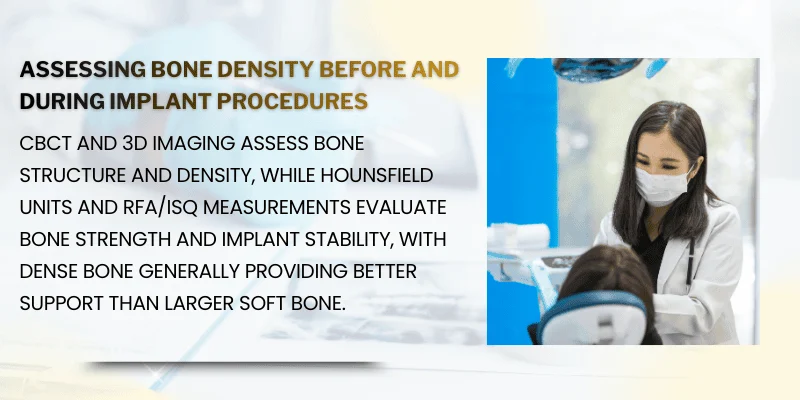
Dentists use several advanced methods to measure bone density both before surgery and while placing implants. These techniques range from detailed imaging that shows bone structure to real-time measurements that help guide treatment decisions.
CBCT and 3D Imaging Techniques
CBCT scans provide detailed three-dimensional views of your jawbone that help dentists plan your dental implant procedure. Unlike traditional X-rays, CBCT imaging captures bone density information along with precise measurements of bone height and width.
These 3D scans allow your dentist to see exactly where nerves and sinuses are located. This helps them choose the best position for your implant and avoid complications.
The technology also reveals areas where bone density might be too low for immediate implant placement. If weak spots are found, your dentist can plan for bone grafting before moving forward with implants.
Understanding Hounsfield Units
Hounsfield units measure bone density on CT scans using a standardized scale. The scale ranges from -1000 for air to +1000 for dense bone, with water at 0.
Your jawbone typically falls between 150 and 850 Hounsfield units depending on the location. Higher numbers mean denser, stronger bone that can better support implants.
Dense cortical bone scores above 850 units, while soft cancellous bone may measure between 150 and 400 units. Your dentist uses these numbers to predict how stable your implant will be and whether modifications to the standard drilling protocol are needed.
Resonance Frequency Analysis (RFA) and Implant Stability Quotient (ISQ)
RFA technology measures implant stability by sending vibrations through the implant and recording how it responds. The device reports this as an ISQ value between 1 and 100.
An ISQ reading above 70 indicates excellent stability, while values between 60 and 70 show acceptable stability. Readings below 60 may signal problems with bone density or implant placement.
Your dentist can use RFA immediately after placing the implant and during follow-up visits. This helps track how well your bone is integrating with the implant over time.
Bone Quality vs. Bone Volume
Bone quality refers to density and internal structure, while bone volume measures the physical amount of bone present. Both factors affect implant success, but quality often matters more than quantity.
You might have plenty of bone volume but poor quality due to conditions like osteoporosis. Conversely, a smaller volume of dense bone can sometimes support an implant better than a larger area of soft bone.
Dentists classify bone quality from D1 to D4, with D1 being the densest and D4 the softest. Your treatment plan changes based on this classification, including adjustments to drilling size and implant design.
Factors That Influence Bone Density and Implant Outcomes
Several factors affect your bone density and how well dental implants hold up over time. Your age, health conditions, and daily habits all play a role in whether your jawbone can support implants successfully.
Age-Related Changes in Bone Density
Your bone density naturally decreases as you get older. This process speeds up after age 50 and affects your jaw just like other bones in your body.
Older adults between ages 66-80 showed significantly lower bone density around implant sites compared to younger patients. The same study found that people in this age group had a 14.56% early failure rate within six months.
Younger patients aged 20-35 only had a 4.99% failure rate. The changes happen because your body absorbs old bone tissue faster than it creates new bone.
This means older adults often need extra planning before getting implants. Your dentist may recommend bone grafting or other treatments to strengthen your jaw first.
Age also affects how quickly your bone heals around the implant. Younger patients typically achieve better stability faster because their bones rebuild more efficiently.
Osteoporosis and Systemic Conditions
Osteoporosis weakens your bones and makes them more porous. This condition directly impacts how bone density affects dental implants by reducing the strength available to hold them in place.
Diabetes also affects your bone health and healing ability. High blood sugar levels can slow down the bone integration process around implants.
People with diabetes face higher infection risks after implant surgery. Periodontal disease damages the bone that supports your teeth.
If you have gum disease, you may already have significant bone loss in your jaw. This makes it harder for implants to succeed without treatment first.
Other health conditions like cardiovascular disease and hypertension can affect blood flow to your jaw. Good blood circulation helps your bones heal and stay strong around implants.
Nutrition, Exercise, and Lifestyle Habits
Your daily habits directly affect your bone mass and density. What you eat and how you move matters for implant success.
Key nutrients for bone health:
- Calcium – Builds and maintains bone strength
- Vitamin D – Helps your body absorb calcium properly
- Protein – Supports bone structure and healing
Weight-bearing exercise strengthens your bones by forcing them to work against gravity. Walking, jogging, and resistance training all help maintain bone density.
These activities signal your body to keep building bone tissue. Smoking reduces blood flow to your bones and slows healing.
It significantly increases implant failure rates. Heavy alcohol use also weakens bones over time by interfering with calcium absorption.
Getting enough sleep helps your body rebuild bone tissue. Your bones repair themselves most actively during rest periods.
Strategies for Managing Low Bone Density in Implantology
Several proven methods allow dentists to successfully place implants even when your jawbone lacks adequate density or volume. These techniques rebuild lost bone structure, work around areas of bone resorption, or use specialized implant designs that anchor in denser bone regions.
Bone Grafting Techniques
Bone grafting adds material to your jaw to increase its volume and density before implant placement. Your dentist may use bone from your own body, donated human bone, animal-derived bone, or synthetic materials.
The graft serves as a scaffold that your natural bone grows into over several months. Different implant placement techniques help improve stability in low-density bone areas.
The grafting material gradually integrates with your existing bone through a process called osseointegration. This creates a stronger foundation for your implant.
Most bone grafting procedures require 3 to 6 months of healing before your dentist can place the implant. The waiting period allows your body to form new bone tissue around the graft material.
Minor grafts can sometimes be done at the same time as implant placement.
Sinus Lift and Bone Regeneration
A sinus lift addresses bone loss in your upper jaw’s back region where the sinus cavity sits close to your mouth. Your dentist lifts the sinus membrane and places bone graft material in the space below it.
This technique creates enough bone height for implant placement. The procedure becomes necessary when your natural bone has worn away due to tooth loss or periodontal disease.
Your maxillary sinus expands downward as bone disappears, leaving insufficient space for standard implants.
Two main approaches exist:
- Lateral window technique – Creates an opening from the side of your jaw
- Osteotome technique – Accesses the area through the implant site itself
Healing takes 4 to 9 months depending on the amount of bone regeneration needed. Modern advancements offer solutions for patients facing significant bone density challenges in implantology.
Zygomatic Implants for Severe Bone Loss
Zygomatic implants anchor into your cheekbone rather than your jawbone when severe bone resorption makes standard implants impossible. These longer implants bypass areas of poor bone quality entirely.
They extend from your upper jaw into the dense zygomatic bone of your cheek. You can receive immediate teeth on the same day as surgery in many cases.
This eliminates the lengthy bone grafting process and multiple surgeries. Zygomatic implants work well for patients who have experienced extensive bone loss from denture wear or missing teeth for many years.
The technique requires specialized training and experience. Your dentist must carefully plan the implant angle and position using 3D imaging.
While more complex than traditional implants, zygomatic implants provide a reliable solution when other options aren’t viable for your situation.
Optimizing Implant Success: Best Practices and Treatment Planning
Successful implant outcomes depend on choosing the right implant design for your bone type and using surgical methods that match your specific needs. Your age, bone quality, and health conditions all require different approaches to maximize implant survival and reduce implant failure.
Selecting Proper Implant Design and Surgical Technique
Your implant’s design directly impacts how well it integrates with your bone. Thread shape and configuration influence primary stability by maximizing contact between bone and implant surface.
When you have lower bone density, your dentist may select implants with wider diameters or specialized surface treatments. These features increase the contact area and help your bone cells attach more effectively during healing.
The surgical technique used during your implant procedure matters just as much as the implant itself. Osseodensification is a newer method that compacts bone instead of removing it during drilling.
This technique increases bone density around the implant site by up to 457 Hounsfield Units in some areas. Your surgeon’s choice between immediate placement and delayed protocols also affects results.
Immediate placement happens right after tooth extraction, while delayed placement waits for bone healing first.
Personalized Protocols for Older Adults and High-Risk Patients
Your treatment plan should account for age-related bone density changes that affect implant stability. Older adults often need modified approaches because bone quality naturally decreases with age.
If you have conditions like diabetes or osteoporosis, your dentist must adjust the implant placement strategy. These conditions slow healing and can increase your risk of implant loss if not properly managed.
Key adjustments for high-risk patients include:
- Extended healing periods before loading the implant
- Bone grafting to improve density before implant placement
- More frequent monitoring appointments
- Modified implant surfaces that promote faster integration
Your dentist should develop a personalized treatment plan based on detailed bone density measurements. This assessment helps predict your implant success rate and identifies whether you need preparatory procedures.
Monitoring Implant Survival and Addressing Early Failure
Regular monitoring helps catch problems before they lead to complete implant failure. Your dentist will check for signs of instability, infection, or bone loss around your implant during follow-up visits.
Early warning signs include pain, swelling, or mobility of the implant. You should report these symptoms immediately because quick intervention can sometimes save a failing implant.
Your implant’s long-term success requires ongoing maintenance. Poor oral hygiene can cause peri-implantitis, an infection that destroys bone around your implant and threatens its survival.
If you experience early failure, your dentist can often place a new implant after addressing the underlying cause and allowing adequate healing time.
Long-Term Considerations for Bone Density and Oral Health
The strength of your dental implants years after placement depends heavily on preventing bone deterioration and maintaining excellent oral hygiene practices. These two factors work together to keep your jawbone stable and your implants secure.
Preventing Bone Loss After Implant Placement
Your jawbone naturally changes over time, and certain conditions can speed up bone loss around your implants. Osteoporosis affects bone density throughout your body, including your jaw, which can influence both initial implant placement and long-term success.
Key factors that affect bone stability include:
- Your overall bone mineral density levels
- Medications that impact bone health
- Hormonal changes, especially in postmenopausal women
- The quality of bone at your implant site
Studies show that even with reduced bone density, implants can still succeed when properly managed. Research on postmenopausal women found that those with osteoporosis experienced similar quality of life improvements as patients with normal bone density after receiving implants.
Your dentist may recommend bone density screenings before treatment. If you have weakened jaw structure, bone grafting procedures can restore enough support to maximize implant longevity.
Maintaining Oral Health to Support Implants
Daily oral hygiene directly impacts how well your bone supports your implants over time. Poor oral health leads to gum disease, which breaks down the bone tissue holding your implants in place.
Essential maintenance practices include:
- Brushing twice daily around implant sites
- Flossing or using interdental brushes to remove plaque
- Scheduling regular dental check-ups to monitor bone stability
- Eating calcium and vitamin D-rich foods
The connection between bone health and dental health means that protecting your bone density helps prevent tooth loss and maintains implant stability. Lower bone mineral density correlates with increased dental problems, including periodontal disease and tooth mobility.
Your diet plays a meaningful role in supporting bone around implants. Foods rich in calcium strengthen your jawbone, while vitamin D helps your body absorb these nutrients effectively.
Avoiding tobacco and limiting alcohol also protects your bone density and reduces your risk of implant complications.
Frequently Asked Questions
Bone density plays a major role in how well dental implants work over time. Many people have questions about specific conditions, medications, and bone quality levels that can affect their treatment options.
What factors impact the success rate of dental implants in patients with varying bone densities?
Several factors work together to determine how well your dental implants will hold up over time. Your age affects your bone quality, with older adults aged 66-80 showing higher failure rates at 14.56% compared to younger patients.
The location of your implant matters too. Upper jaw bone tends to be less dense than lower jaw bone, which can affect how stable your implant becomes.
Your overall health plays a role as well. If you smoke, have diabetes, or take certain medications, these factors can slow down the healing process.
The bone needs to fuse properly with the implant through a process called osseointegration. The skill of your dentist and the type of implant used also influence your results.
Your dentist will measure your bone density using special scans before placing the implant.
How does osteoporosis influence the long-term strength and stability of dental implants?
Osteoporosis makes your bones more porous and less dense throughout your body, including your jaw. This condition can make it harder for dental implants to stay secure over time.
The disease changes the way your bone cells work. Your body breaks down old bone faster than it creates new bone, which weakens the foundation that holds your implant in place.
Research shows that patients with osteoporosis may experience slower healing after implant placement. The bone takes longer to grow around and attach to the implant post.
However, having osteoporosis doesn’t automatically mean you can’t get dental implants. Many people with this condition successfully receive implants when their dentist takes extra precautions.
Your dentist might suggest longer healing times or additional procedures to strengthen your jaw bone first.
Can individuals on osteoporosis medications like bisphosphonates safely receive dental implants?
You can often receive dental implants while taking bisphosphonates, but your dentist needs to know about these medications beforehand. Bisphosphonates help prevent bone loss but can sometimes slow down healing in your jaw.
The type of bisphosphonate matters. Oral medications that you take by mouth typically pose less risk than IV versions given in a hospital setting.
How long you’ve taken the medication and your dosage also affect your treatment plan. Your dentist will work with your doctor to decide if you should pause your medication before getting implants.
Some dentists recommend stopping bisphosphonates for a few months before and after implant surgery. This break helps your jaw heal properly while still protecting your bone health in the long run.
The risk of complications is relatively low for most patients. Your dental team will monitor your healing closely and adjust your treatment if needed.
What are the potential challenges when placing dental implants in areas with different bone quality categories (D1, D2, D3, D4)?
Dentists classify bone density into four categories from D1 to D4, with each type presenting its own set of challenges. D1 bone is very dense and hard, which can make drilling difficult but provides excellent stability once the implant is in place.
D2 bone offers the best balance for most implants. It’s dense enough to hold the implant securely but not so hard that it creates problems during placement.
D3 bone is softer and more porous. Your implant might not feel as stable right after surgery, and you may need a longer healing period before getting your permanent crown.
D4 bone is the softest and poses the biggest challenge. This type is most common in the back part of your upper jaw.
Implants in D4 bone have higher failure rates and often require special techniques like bone grafting. Your dentist might use wider or longer implants in softer bone to increase surface contact.
They may also place the implant at a specific angle to reach denser bone areas.
Is there a recommended bone density level for optimal dental implant integration and longevity?
D2 bone density typically provides the best conditions for dental implant success. This bone type has enough density to support the implant while still allowing good blood flow for healing.
Your jaw bone needs to measure at least 1-2 millimeters thick around all sides of the implant. The bone should also be tall enough to support the full length of the implant post, usually at least 10 millimeters in most cases.
Dentists measure bone density using CT scans that show Hounsfield units. Values between 850-1250 HU generally indicate good bone quality for implants.
However, you don’t need perfect bone to get implants. Modern techniques allow dentists to work with various bone densities.
What matters most is having enough bone volume and quality to support the specific implant your dentist plans to use. Your dentist will evaluate your individual bone health to determine eligibility for treatment.
They might recommend preparatory procedures if your bone needs strengthening first.
How do treatments for bone loss affect the overall cost and prognosis of dental implants?
Bone grafting procedures add both time and expense to your implant treatment. A simple bone graft might cost between $300-$800.
More complex grafts can run $2,000 or higher. You’ll also need to wait longer for your final teeth.
Bone grafts typically need 3-6 months to heal before your dentist can place the implant. This extends your total treatment time significantly.
Your insurance might cover part of the bone grafting cost. Many plans consider it a separate procedure from the implant itself.
You should check your coverage details before starting treatment. Some dentists offer financing plans to help spread out the cost of bone grafting and implants.