

Overview: Full-mouth restoration (FMR) refers to comprehensive prosthetic rehabilitation of an entire dental arch or both arches. In 2025, FMR cases remain a small but growing segment of restorative dentistry, driven by an aging population, high rates of tooth loss, and advances in implant and prosthetic technology.
No single registry tracks “full-mouth” cases, so national and local estimates must be inferred from oral health data, dental service utilization, and market reports. In the U.S., an estimated 178 million adults are missing at least one tooth and roughly 40 million are edentulous (all teeth lost).
Among seniors, national surveys show about 12–13% of those 65+ have lost all their teeth (versus 17% in Louisiana).
National Utilization: Nationwide, only about 45% of adults report visiting a dentist in the past year. Dental care spending has risen steadily – total U.S. expenditures were $174 billion in 2023.
However, restorative and prosthetic procedures (crowns, implants, dentures) are concentrated among older and higher-need patients. Implant dentistry reflects one aspect: roughly 3 million implants are placed annually in the U.S.. Industry analysts estimate the U.S. dental implants market was about $2.12 billion in 2024, growing to over $3.15 billion by 2030.
All major full-arch solutions (e.g. “All‑on‑X” implants) fall within this market. A related estimate finds the U.S. dental prosthetics market (dentures, bridges, implants, etc.) at $1.80 billion in 2025, projected to exceed $3.64 billion by 2034 (CAGR ~8%).
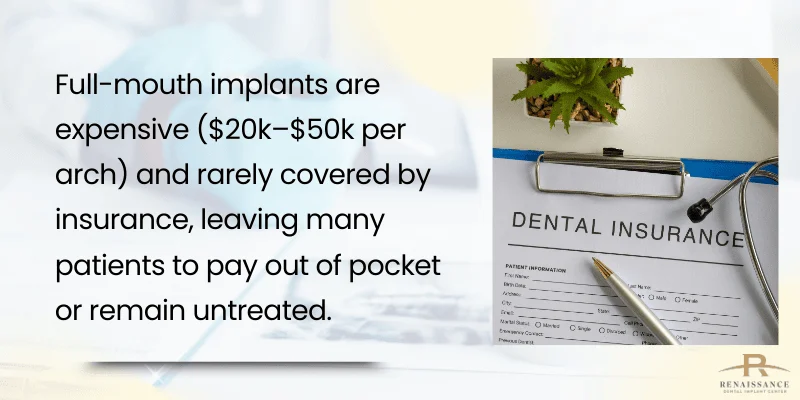
These figures imply substantial demand for full-mouth restorations, since complete-arch cases (e.g. implant-supported dentures) can cost $20,000–$50,000 per arch.
Explore full mouth restoration statistics and treatment options available near Metairie, LA.
Louisiana (2025): Louisiana’s oral health ranks near the bottom nationally. Only 60.4% of Louisiana adults reported a dental visit in the past year (ranked 41st among states), versus 73–74% in top states. Statewide, 17.2% of seniors (65+) have lost all teeth – substantially higher than the U.S. average (12.1%).
Reflecting this burden, nearly 40% of Louisiana seniors had lost six or more teeth, and 18% lost all teeth by late 2024. These deficits translate into a large pool of potential FMR patients.
Louisiana also faces workforce and access challenges: it has only 24.7 dentists per 100,000 population (well below many states), and about 8–9% of adults have no dental insurance. Medicaid in Louisiana covers very limited adult dentistry: exams, X‑rays and complete/partial dentures only.
Major restorative procedures (crowns, implants) are generally not covered. In sum, Louisiana’s population has high tooth-loss needs but faces financial and access barriers to full-arch care.
New Orleans (2025): Orleans Parish (New Orleans) lacks direct public data on FMR, but local context suggests high unmet need. New Orleans has historically had higher poverty rates (over 40% of children below poverty) and significant uninsured pockets (e.g. ~24% of Hispanic adults uninsured). Recent health reports emphasize stark racial and socioeconomic disparities in access.
For example, Orleans Medicaid expansion boosted insurance overall, but segments (e.g. Hispanic, low-income residents) still face barriers. Anecdotal reports note a shortage of dentists in some neighborhoods and high emergency extraction rates.
The local dental market includes specialists (the New Orleans Dental Association has implant-trained prosthodontists and oral surgeons), but full-arch services are mostly provided in private clinics, often requiring self-pay. In practice, full-mouth rehab in New Orleans is likely limited to well-insured or out-of-state patients. In summary,
New Orleans’ oral health needs (high edentulism rates, limited preventive care) suggest substantial latent demand for FMR, but actual case volumes are constrained by insurance and socioeconomic factors.
Patient Demographics: Full-mouth restoration patients are overwhelmingly older adults with significant tooth loss. National data show edentulism and severe tooth loss increase with age: only about 13% of Americans 65–74 have no teeth, rising to 26% of those 75+.
As a result, patients in their 60s–80s make up most FMR cases. Demographically, rates of complete dental loss are highest among American Indian/Alaska Native and Black seniors, as well as those with low income or education.
America’s Health Rankings notes that edentulism (full extraction due to decay/gum disease) is 8 times higher in those without a high-school diploma versus college grads, and ~5.5 times higher in <$25k incomes vs $75k+. Urban/rural disparities exist too: rural elders have higher complete tooth loss than metropolitan counterparts. Women and men show smaller differences. In Louisiana, similar patterns hold.
Overall, FMR patients tend to be older, minority or lower-income individuals who have experienced cumulative oral disease.

Market Growth & Trends: Demand for FMR is rising. Factors include the aging Baby Boomer cohort, improved surgical techniques, and patient preference for fixed, high-function restorations. Industry analysts cite an ~8–9% annual growth in implants and prosthetics markets through 2030.
Technological innovations (3D printing, digital CAD/CAM, AI-guided planning, robotic-assisted surgery) are making full-arch treatments more predictable and widespread.
Minimally invasive protocols (e.g. immediate-load “teeth in a day” with 4–6 implants per arch) have gained popularity. At the same time, new materials (titanium, zirconia, PEEK) and smart implants are emerging.
These advances are driving volume: one market report projects the global full-mouth implant market to nearly $19 billion by 2030. In the U.S. specifically, the implant segment should double in a decade. Even traditional dentures are getting supplanted by implant-retained prostheses where feasible.
Finally, dental tourism (notably to Mexico) has risen, indicating some U.S. patients seek lower-cost full-arch care abroad.
Learn how tooth loss trends and aging populations are increasing demand for full mouth restoration.
Insurance and Access: Full-mouth cases are among the most expensive dental services. Typical full-arch implant restorations cost $20–50k per arch, often beyond most insurance plans. Medicare offers virtually no dental coverage for adults, leaving seniors to pay out of pocket or through supplemental plans.
Medicaid adult dental benefits vary by state; in Louisiana they are very limited (covering mainly dentures, not implants or crowns). Private dental insurance may cover portions of restorative work, but many plans have annual caps ($1–2k) that fall far short of full-arch costs.
Consequently, a large share of full-mouth patients pay out-of-pocket or use financing. Low-income and Medicaid-eligible patients often remain untreated or receive only extractions. (Notably, about 57% of private-plan adults saw a dentist in 2022, versus only 18% of Medicaid adults, illustrating coverage gaps.)
Forecast (2026+): Trends point to continued growth in FMR demand. The 65+ U.S. population is projected to reach ~82 million by 2050, many with partial edentulism and desire for stable chewing. Implant dentistry and prosthetics will capture a larger share: U.S. prosthetics market to double by 2034, and implant procedures likely grow ~7–9% annually.
Advances will lower unit costs modestly (mass production of components, generics), improving affordability. Tele-dentistry and AI may streamline diagnostics and patient outreach, while expanding clinics (DSOs, chain providers) could increase treatment volumes.
If policy changes add senior dental benefits (e.g. Medicare reform), access to full-arch care could surge among retirees. However, workforce and access challenges will persist: rural and low-income communities may remain underserved, sustaining pent-up demand. Locally,
New Orleans and Louisiana’s urban centers may see modest increase in cases as more clinics adopt implant technology, but nationwide growth will largely follow demographic shifts and economic factors.
Key Takeaways: In 2025 the U.S. sees tens of thousands of full-mouth reconstructions (implants plus prosthetics) annually, with rising trends into 2026 and beyond. Nationally, aging and high rates of tooth loss underpin this need: roughly half of U.S. seniors have lost six or more teeth, and ~12% are completely toothless.
Louisiana exceeds national averages: over 17% of its seniors are edentulous, and only ~60% of adults see a dentist each year. These factors suggest substantial unmet need for comprehensive rehabilitation in Louisiana and New Orleans.
Demographic studies show FMR patients disproportionately come from older, minority, lower-income, and rural populations. Market analyses predict strong growth (8–9% CAGR) in implant and prosthetic dentistry through 2030, implying expanding FMR case volumes.
However, high costs ($20–50k per arch) and limited insurance coverage constrain uptake. Dental professionals should anticipate increasing demand from aging baby boomers and prepare to address access gaps.
Sources: Data are drawn from government surveys (CDC/BRFSS via America’s Health Rankings), ADA Health Policy Institute reports, and industry analyses. Key references include American Dental Association utilization and spending reports, America’s Health Rankings (LA dental visits and edentulism), Louisiana Dept. of Health/HPSA reports, and recent market research on dental implants and prosthetics.