


Losing a tooth affects more than just your smile. It can make eating difficult, change how you speak, and impact your confidence in social situations.
Dental implants offer better stability, longer-lasting results, and help preserve your jawbone health compared to dentures and bridges.
Unlike other options that sit on top of your gums or attach to nearby teeth, implants work like natural tooth roots. They fuse with your jawbone to create a strong foundation that can last for decades with proper care.
Understanding why dental implants provide unmatched stability helps you make the right choice for your oral health. This guide walks you through the key differences between implants and other tooth replacement methods so you can decide what works best for your needs.
Key Takeaways
- Dental implants fuse with your jawbone to provide stability that other replacement options cannot match
- Implants help preserve your jawbone and prevent bone loss that occurs with dentures and bridges
- While implants cost more upfront, they typically last longer and require less maintenance than traditional replacement methods
Visit Renaissance Dental Implant Center in Metairie, LA to explore your tooth replacement options.
What Makes Dental Implants Unique?
Dental implants stand apart from other tooth replacement options because they replicate the entire tooth structure from root to crown and fuse directly with your jawbone through a natural biological process.
Understanding Artificial Tooth Roots and Osseointegration
When you lose a tooth, you lose both the visible crown and the root beneath your gums. Dental implants are the only tooth replacement option that addresses both parts by serving as artificial tooth roots surgically placed into your jawbone.
The magic happens through osseointegration. This is the process where your dental implant forms a direct bond with your surrounding jawbone, creating a solid and stable base for your replacement tooth.
The word comes from Latin: osseo meaning “bone” and integration meaning “to make whole.”
Over several months, your bone cells grow around the implant post and fuse with it. This creates a permanent foundation that won’t shift or slip like dentures.
Once the implant integrates with your bone, a crown, bridge, or denture is attached on top, creating a secure and natural-looking replacement.
The Dental Implant Procedure Explained
Your dental implant procedure typically happens in multiple stages over several months. First, your dentist surgically places the titanium post into your jawbone where your tooth is missing.
After implant placement, you’ll need a healing period of three to six months. During this time, osseointegration occurs as your bone grows around the implant. Your dentist may place a temporary restoration so you’re not without a tooth during healing.
Once healing is complete, your dentist attaches a small connector piece called an abutment to the implant. Finally, they secure your custom-made crown, bridge, or denture to the abutment.
The entire implant procedure requires patience, but the result is a tooth replacement that functions just like your natural teeth.
Why Biocompatible Titanium Matters
Most dental implants are made from biocompatible titanium, a material your body accepts without rejection. Titanium has unique properties that make it ideal for dental implant solutions.
Your body doesn’t recognize titanium as a foreign object. Instead, your bone cells attach directly to the titanium surface during osseointegration. This biocompatibility is why dental implants have a success rate of over 95%.
Titanium is also incredibly strong yet lightweight. It can withstand the daily forces of chewing and biting without breaking or corroding in your mouth.
This durability is one reason why your implants can last 20 years or more with proper care, unlike other replacement options that need frequent adjustments or replacements.
Schedule your exam now to learn if dental implants are right for you.
Comparing Dental Implants to Other Tooth Replacement Options
When you’re exploring teeth replacement options, understanding how dental implants stack up against alternatives helps you make the right choice. Each solution offers different benefits in terms of comfort, durability, and how they affect your surrounding teeth and jawbone.
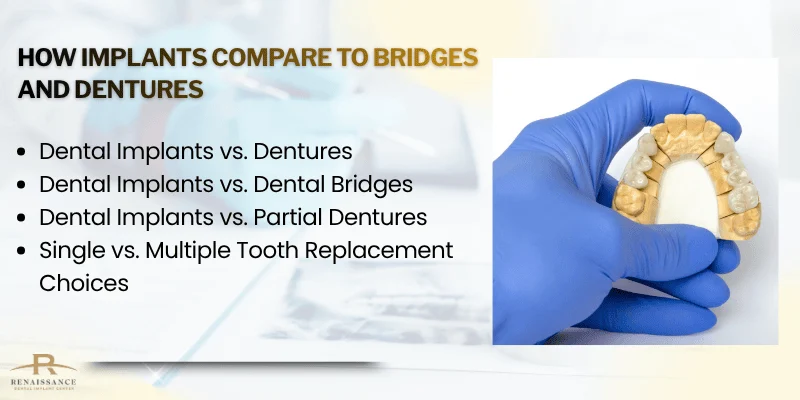
Dental Implants vs. Dentures
Removable dentures sit on top of your gums and rely on suction or adhesive to stay in place. While they’re a common choice for replacing multiple missing teeth, they can slip when you eat or speak.
Dental implants, on the other hand, are permanently anchored into your jawbone. This means you won’t worry about embarrassing slips or the need for messy adhesives. Dentures can also speed up bone loss in your jaw because they don’t stimulate the bone like natural teeth do.
Key differences:
- Implants feel and function like your natural teeth
- Dentures require removal for cleaning and overnight soaking
- Implants preserve your jawbone structure
- Dentures may need adjustments or replacements every 5-8 years
You’ll find that implants let you eat whatever you want without restrictions, while dentures often limit your food choices.
Dental Implants vs. Dental Bridges
A dental bridge anchors replacement teeth to your existing natural teeth on either side of the gap. Your dentist must file down these healthy neighboring teeth to place crowns that support the bridge.
This process permanently alters teeth that might otherwise stay healthy for years. Dental bridges typically last 10-15 years before needing replacement, while implants can last decades with proper care.
Bridges don’t address the bone loss problem either. Without a root to stimulate your jawbone, the bone beneath a bridge gradually deteriorates. Implants act as artificial roots, keeping your jawbone strong and healthy.
Maintenance comparison:
- Bridges require special flossing techniques to clean underneath
- Implants brush and floss just like regular teeth
- Adjacent teeth remain untouched with implants
Dental Implants vs. Partial Dentures
Partial dentures use metal clasps to hook onto your remaining natural teeth. They’re removable like full dentures but designed to fill in gaps when you still have some healthy teeth left.
These clasps can put pressure on the teeth they attach to, potentially loosening them over time. You’ll need to remove your partials for cleaning, and they can feel bulky in your mouth. Food particles often get trapped underneath, requiring extra attention after meals.
Implants integrate with your bone and don’t rely on other teeth for support. Each implant stands independently, protecting your remaining natural teeth from extra stress.
You can choose implants for individual missing teeth or use them to support a fixed bridge, giving you more flexibility in your long-term tooth replacement strategy.
Single vs. Multiple Tooth Replacement Choices
For a single missing tooth, an implant replaces just that tooth without involving adjacent teeth. This preserves your healthy tooth structure better than any alternative.
When you’re missing several teeth, you have multiple paths forward. Individual implants can replace each tooth separately, or you might use implant-supported bridges where fewer implants support multiple replacement teeth.
For a full arch, implant-supported dentures combine stability with more affordable pricing than individual implants for every tooth.
Options for multiple teeth:
- All-on-4: Four implants support a full arch of teeth
- Implant-supported bridge: Two implants hold several replacement teeth
- Individual implants: Separate implants for each missing tooth
Your jawbone density, budget, and personal preferences all factor into which tooth replacement options work best for your situation.
Contact our Metairie, Louisiana office today to schedule your implant consultation.
Benefits of Dental Implants Over Traditional Methods
Dental implants provide key advantages that set them apart from dentures and bridges. They work like natural tooth roots, which gives you better stability, improved ability to eat and speak, and a more comfortable daily experience.

Superior Stability and Natural Appearance
Dental implants fuse directly with your jawbone through a process called osseointegration. This creates a strong foundation that won’t slip or move when you eat or talk. Unlike dentures that can shift around in your mouth, implants stay firmly in place.
The natural appearance of dental implants makes them almost impossible to tell apart from your real teeth. Your dentist custom-makes each crown to match the color, shape, and size of your surrounding teeth.
This means you can smile, laugh, and talk without worrying about anyone noticing your tooth replacement.
Implants also help preserve your facial structure. When you lose teeth, your jawbone can shrink over time, which changes the shape of your face. Implants stimulate the bone just like natural teeth do, keeping your jaw healthy and maintaining your natural look.
Improved Chewing and Speaking Function
You can bite and chew with nearly the same force as natural teeth when you have implants. This means you don’t need to avoid hard or crunchy foods like apples, nuts, or corn on the cob. Traditional dentures often limit what you can eat because they rest on your gums rather than anchoring into bone.
Speaking clearly becomes easier with implants since they don’t move around in your mouth. Dentures can sometimes slip when you talk, causing clicking sounds or slurred speech.
With improved functionality from dental implants, you can speak confidently without worrying about your teeth shifting.
Enhanced Comfort and Convenience
Implants feel like your own teeth because they become part of your jaw. You don’t need to deal with messy adhesives or take them out at night like you would with dentures. This makes your daily routine simpler and more comfortable.
Many people find that implants eliminate the sore spots and irritation that dentures can cause on your gums. Since implants don’t press down on soft tissue, they’re generally more comfortable to wear all day long.
You also don’t need to alter healthy teeth next to the gap, which is required when getting a traditional bridge.
Oral Health and Bone Preservation Advantages
Dental implants actively stimulate your jawbone and prevent the bone deterioration that occurs with missing teeth. They maintain your facial structure and protect neighboring teeth from shifting or damage.
Prevention of Jawbone Atrophy and Bone Loss
When you lose a tooth, your jawbone stops receiving the stimulation it needs to maintain its density. Without this stimulation, your jawbone begins to deteriorate in a process called jawbone atrophy.
Dental implants prevent bone loss by replacing the tooth root and mimicking its natural function. The titanium post fuses with your jawbone through a process called osseointegration. This creates a stable foundation that sends signals to your body to keep rebuilding bone tissue.
Other replacement options like bridges and dentures sit on top of your gums without reaching the bone. Your body interprets this as a sign that the bone is no longer needed. You can lose 25% of your jawbone width within the first year after tooth loss if you don’t address it properly.
Maintaining Jawbone Health and Facial Structure
Jawbone preservation does more than just keep your jaw strong. It maintains the shape of your face and prevents the sunken appearance that many people develop after losing teeth.
Your facial muscles and skin rely on the support of your underlying bone structure. When your jawbone shrinks, your cheeks can appear hollow and your lips may look thinner. This bone loss can make you look older than you actually are.
Implants preserve your natural facial contours by keeping your jawbone intact. They distribute bite forces throughout your jaw just like natural teeth. This constant stimulation tells your body to maintain bone density in that area, which keeps your face looking full and youthful.
How Implants Protect Overall Oral Health
Your improved oral health extends beyond just the implant site. Unlike bridges, implants don’t require grinding down healthy adjacent teeth for support.
Dental implants preserve your oral health by functioning independently. You can brush and floss around them just like your natural teeth. This makes it easier to maintain good hygiene and reach your oral health goals.
When teeth are missing, your remaining teeth can shift into the empty spaces. This creates bite problems and makes teeth harder to clean. Implants fill these gaps and keep your other teeth in their proper positions.
They also eliminate the food traps that can develop with bridges, reducing your risk of decay and gum disease in surrounding teeth.
Candidacy, Versatility, and Considerations for Dental Implants
Dental implant candidacy depends on biology, not age, making them accessible to most adults with missing teeth.
These replacement options work for single tooth loss or complex cases involving multiple missing teeth, with modern techniques like All-on-4 providing solutions even when bone density is limited.

Who Is a Good Candidate for Dental Implants?
Your dentist will assess several key health and oral conditions to determine if you qualify for dental implants. The main factors include jawbone density, gum health, and your body’s ability to heal properly.
You need adequate bone in your jaw to support the implant post. If you’ve experienced tooth loss years ago, your bone may have shrunk over time. However, bone grafting can often solve this problem.
Good gum health is essential for implant success. Active gum disease needs treatment before implant placement. Your body must also heal well after surgery, which means conditions like uncontrolled diabetes or heavy smoking may affect your candidacy.
Most people with missing teeth qualify for implants regardless of when they lost their teeth. Your dentist will review your medical history and take X-rays to create a personalized treatment plan.
Addressing Multiple Missing Teeth and Complex Cases
You don’t need one implant for each missing tooth when dealing with multiple missing teeth. Dental implants can support bridges that replace several teeth at once, making treatment more affordable and less invasive.
For example, two implants can hold a bridge replacing three or four consecutive teeth. This approach in restorative dentistry gives you stable results without placing an implant in every gap.
Even if you’ve lost most or all teeth in one arch, implants remain a viable option. Implants replace single, multiple, or all missing teeth without affecting your healthy adjacent teeth.
Complex cases may require additional procedures like bone grafting or sinus lifts. These preparatory steps create the foundation needed for successful implant placement. Your treatment timeline may extend, but the long-term results make it worthwhile.
Special Options: All-on-4 and Implant-Supported Prosthetics
The All-on-4 technique uses just four strategically placed implants to support a full arch of replacement teeth. This method works even if you have reduced bone density in certain areas.
The back implants are angled to maximize contact with existing bone, avoiding areas where bone loss is severe. You can often receive temporary teeth the same day as implant placement.
Implant-supported dental prosthetics offer more stability than traditional dentures. These restorations snap onto or screw into implants, eliminating the slipping and discomfort associated with conventional dentures.
You can choose between fixed options that stay in place permanently or removable versions you take out for cleaning. Both types provide better chewing function than traditional dentures.
Your dentist will help you select the best prosthetic design based on your bone structure, budget, and lifestyle needs.
Long-Term Value, Maintenance, and Cost Considerations
Dental implants require an upfront investment but deliver decades of reliable function with proper care. Understanding their durability, maintenance needs, and true costs helps you make an informed decision about your oral health.
Durability and Longevity of Dental Implants
Dental implants can last 20 to 30 years or even a lifetime with proper care. This exceptional lifespan comes from the osseointegration process, where titanium posts fuse directly with your jawbone to create a stable foundation.
Unlike dentures that need replacement every few years, dental implants provide decades of reliable function with minimal additional expenses. Bridges typically require replacement every 10 to 15 years, making implants more durable over time.
Several factors affect how long your implants will last:
- Daily oral hygiene practices like brushing and flossing
- Regular dental checkups for professional cleaning
- Lifestyle choices such as smoking cessation
- Overall health conditions like diabetes management
The titanium construction resists decay and withstands normal chewing forces. Your natural bone grows around the implant, strengthening the bond over time and preventing the bone loss that occurs with missing teeth.
Oral Hygiene and Maintenance Tips
Caring for your dental implants is straightforward and similar to maintaining natural teeth. You don’t need special cleaning solutions or overnight soaking like dentures require.
Daily care includes:
- Brushing twice daily with a soft-bristled toothbrush
- Flossing around implants to remove plaque
- Using antimicrobial mouthwash to reduce bacteria
- Avoiding hard foods that could damage the crown
Schedule regular dental visits every six months for professional cleaning and monitoring. Your dentist will check for peri-implantitis, an inflammatory condition that can threaten implant stability if left untreated.
Good oral hygiene prevents complications and ensures your implants remain healthy for decades. The maintenance routine takes no more time than caring for natural teeth, making implants convenient for daily life.
Evaluating the Cost of Dental Implants
The cost of dental implants initially appears higher than dentures or bridges. A single implant typically ranges from $3,000 to $6,000, including the post, abutment, and crown.
However, implants prove more cost-effective over time compared to alternatives requiring frequent replacements. Dentures need adjustments and replacements every few years, adding up to significant expenses over decades.
Hidden costs you avoid with implants:
- Denture adhesives and cleaning solutions
- Frequent dentist visits for adjustments
- Replacement costs every 5-7 years for dentures
- Repairs for broken or worn components
Some dental insurance plans now offer partial coverage for implants due to their long-term benefits. Many dental offices provide financing options with monthly payment plans to make treatment more accessible.
When you calculate the total investment over 20 to 30 years, implants often cost less than repeatedly replacing other dental solutions. You also gain improved quality of life and oral health that alternatives cannot match.
Frequently Asked Questions
Dental implants raise common questions about their advantages, longevity, procedures, success rates, candidacy requirements, and long-term oral health impact. Understanding these details helps you make an informed decision about your tooth replacement options.
What are the main benefits of choosing dental implants over dentures?
Dental implants provide stability that dentures cannot match. Unlike dentures that can slip or move while you eat or speak, implants feel like a natural part of your mouth, allowing you to speak and chew properly without worry.
You gain the same biting force as natural teeth with implants. This means you can enjoy a wide range of foods without restrictions, while traditional dentures often limit what you can comfortably eat.
Implants also preserve your jawbone by integrating with it through a process called osseointegration. Dentures rest on your gums and do not prevent bone loss over time, which can change the shape of your face.
How long do dental implants typically last compared to bridges?
Dental implants can last a lifetime with proper care. Their titanium construction and integration with your jawbone create a permanent solution that does not need regular adjustments or replacements.
Bridges typically need replacement every 5 to 15 years due to wear and potential damage to supporting teeth. The long-term cost of a bridge can exceed that of an implant because of these repeated replacements and maintenance needs.
Your implants require the same basic care as natural teeth. Regular brushing, flossing, and dental checkups keep them functioning well for decades.
Can you explain the process of getting a dental implant?
The process begins with an initial consultation where your dentist examines your mouth and takes 3D X-rays. This evaluation determines if implants are the right treatment option for you.
During the second stage, your dentist surgically places a titanium post into your jawbone under local anesthesia. The healing period called osseointegration takes several months as the post fuses with your bone.
Once healing completes, your dentist attaches an abutment or connector to the implant. This piece serves as the attachment point for your final crown or denture.
The final step involves placing your custom-made permanent tooth onto the abutment. This completes your restoration and gives you a natural-looking smile.
What are the success rates for dental implants versus other tooth replacement options?
Dental implants have high success rates when placed by experienced professionals. The biocompatible titanium material allows proper integration with your jawbone, creating a stable foundation that rarely fails.
Traditional options like bridges and dentures do not fail in the same way, but they require frequent adjustments and replacements. These maintenance needs add up over time and can affect your comfort and confidence.
Certain factors influence implant success, including your overall health and oral hygiene habits. Quitting smoking and maintaining good dental care improve your chances of long-term success.
Are dental implants a good solution for anyone with missing teeth?
Dental implants work well for many people but are not suitable for everyone. You need good oral health, sufficient jawbone density, and healthy gums to be an ideal candidate for implant treatment.
Some medical conditions can affect implant success. Uncontrolled diabetes and autoimmune problems may interfere with the healing process and osseointegration.
Your dentist will evaluate your oral health and review your medical history during consultation. In some cases, bone grafting or other preparatory procedures help create a healthy foundation for successful implant placement.
How do dental implants improve oral health in the long term?
Implants preserve your natural teeth by not requiring alterations to neighboring teeth. Bridges need the grinding down of adjacent healthy teeth to serve as anchors, which weakens those teeth over time.
Your jawbone stays healthy and strong with implants. The titanium posts stimulate bone tissue just like natural tooth roots, preventing the bone loss that occurs with dentures and bridges.
Implants make cleaning easier compared to other options. You can brush and floss around them like natural teeth, reducing your risk of gum disease and decay in surrounding teeth.